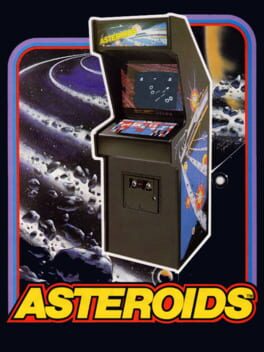
Asteroids
Asteroids is an arcade space shooter released in November 1979. The player controls a spaceship in an asteroid field which is periodically traversed by flying saucers. The objective of the game is to destroy both, asteroids and saucers. The triangular ship can rotate left and right, fire shots straight forward, and thrust forward. Once the ship begins moving in a direction, it will continue in that direction for a time without player intervention unless the player applies thrust in a different direction. The ship eventually comes to a stop when not thrusting. The player can also send the ship into hyperspace, causing it to disappear and reappear in a random location on the screen, at the risk of self-destructing or appearing on top of an asteroid.
| Released | 1979 |
|---|---|
| Developer | Atari |
| Publisher | Adventure International |
Platforms & ports
| System | Year | Region | Notes |
|---|---|---|---|
| ARC Arcade ★ original | 1979 | — | — |
Screenshots
3images — scroll sideways, click to enlarge
Video
History
Asteroids is a 1979 multidirectional shooter video game developed and published by Atari, Inc. for arcades. It was released by Taito and Sega in Japan. The player controls a spaceship in an asteroid field which is periodically traversed by flying saucers. The object of the game is to shoot and destroy the asteroids and saucers while avoiding colliding with either or being hit by the saucers' counterfire. The game becomes more difficult as the number of asteroids increases.
Asteroids was conceived and designed by Lyle Rains and Ed Logg, who decided to use hardware developed by Wendi Allen (then known as Howard Delman) that was previously used for Lunar Lander. Asteroids was based on an unfinished game titled Cosmos; its physics model, control scheme, and gameplay elements were derived from Spacewar!, Computer Space, and Space Invaders and refined through trial and error. The game is rendered on a vector display in a two-dimensional view that wraps around both screen axes.
Asteroids was one of the first major hits of the golden age of arcade games; the game sold 47,840 upright cabinets and 8,725 cocktail cabinets, and proved both popular with players and influential with developers. In the 1980s, it was ported to Atari's home systems, with the Atari 2600 version selling over three million copies. The game was widely imitated, and directly influenced Defender, Gravitar, and many other video games.
Gameplay
The objective of Asteroids is to destroy asteroids and saucers. The player controls a triangular ship that can rotate left and right, fire shots straight forward, and thrust forward. Once the ship begins moving in a direction, it will continue in that direction for a time without player intervention unless the player applies thrust in a different direction. The ship eventually loses momentum and comes to a stop when not thrusting. The player can also send the ship into hyperspace, causing it to disappear and reappear in a random location on the screen, at the risk of self-destructing or appearing on top of an asteroid.
Each level starts with multiple large asteroids drifting across the screen. Objects wrap around screen edges; an asteroid that drifts off the top edge of the screen reappears at the bottom and continues moving in the same direction. As the player shoots asteroids, they break into smaller asteroids that move faster and are more difficult to hit. Smaller asteroids are also worth more points. Two flying saucers appear periodically on the screen; the "big saucer" shoots randomly and poorly, while the "small saucer" fires frequently at the ship. After reaching a score of 40,000, only the small saucer appears. As the player's score increases, the angle range of the shots from the small saucer diminishes until the saucer fires extremely accurately. Once the screen has been cleared of all asteroids and flying saucers, a new set of large asteroids appears, thus starting the next level. The game gets harder as the number of asteroids increases until after the score reaches a range between 40,000 and 60,000. The player starts with 3–5 lives upon game start and gains an extra life per 10,000 points. Play continues to the last ship lost, which ends the game. The machine "turns over" at 99,990 points, which is the maximum high score that can be achieved.
Lurking exploit
In the original game design, saucers were supposed to begin shooting as soon as they appeared, but this was changed. Additionally, saucers can only aim at the player's ship on-screen; they are not capable of aiming across a screen boundary. These behaviors allow a "lurking" strategy, in which the player stays near the edge of the screen opposite the saucer. By keeping just one or two rocks in play, a player can shoot across the boundary and destroy saucers to accumulate points indefinitely with little risk of being destroyed. Arcade operators began to complain about losing revenue due to this exploit. In response, Atari issued a patched EPROM and, due to the impact of this exploit, Atari (and other companies) changed their development and testing policies to try to prevent future games from having such exploits.
Development
Asteroids was conceived by Lyle Rains and programmed by Ed Logg with collaborations from other Atari staff. Logg was impressed with the Atari Video Computer System (later called the Atari 2600), and he joined Atari's coin-op division to work on Dirt Bike, which was never released due to an unsuccessful field test. Paul Mancuso joined the development team as Asteroids' technician and engineer Wendi Allen contributed to the hardware. During a meeting in April 1979, Rains discussed Planet Grab, a multiplayer arcade game later renamed to Cosmos. The unfinished game featured a giant, indestructible asteroid. Logg did play Cosmos and remembered shooting the indestructible asteroid to no effect. So Rains asked Logg: "Well, why don't we have a game where you shoot the rocks and blow them up?" In response, Logg described a similar concept where the player selectively shoots at rocks that break into smaller pieces. Thus combining the two-dimensional approach of Space War with Space Invaders' addictive gameplay of "completion" and "eliminate all threats". Both agreed on the concept.
Hardware
Asteroids was implemented on hardware developed by Allen and is a vector game, in which the graphics are composed of lines drawn on a vector monitor. Rains initially wanted the game done in raster graphics, but Logg, experienced in vector graphics, suggested an XY monitor because the high image quality would permit precise aiming. The hardware is chiefly a MOS 6502 executing the game program, and QuadraScan, a high-resolution vector graphics processor developed by Atari and referred to as an "XY display system" and the "Digital Vector Generator (DVG)".
The original design concepts for QuadraScan came out of Cyan Engineering, Atari's off-campus research lab in Grass Valley, California, in 1978. Cyan gave it to Wendi Allen, who finished the design and first used it for Lunar Lander. Logg received Allen's modified board with five buttons, 13 sound effects, and additional RAM, and he used it to develop Asteroids. The size of the board was 4 by 4 inches, and it was "linked up" to a monitor.
Implementation
Logg modeled the player's ship, the five-button control scheme, and the game physics after Spacewar!, which he had played as a student at the University of California, Berkeley, but made several changes to improve playability. The ship was programmed into the hardware and rendered by the monitor, and it was configured to move with thrust and inertia. The hyperspace button was not placed near Logg's right thumb, which he was dissatisfied with, as he had a problem "tak[ing] his hand off the thrust button". Drawings of asteroids in various shapes were incorporated into the game. Logg copied the idea of a high score table with initials from Exidy's Star Fire.
The two saucers were formulated to be different from each other. A steadily decreasing timer shortens intervals between saucer attacks to keep the player from not shooting asteroids and saucers. A "heartbeat" soundtrack quickens as the game progresses. The game does not have a sound chip. Allen created a hardware circuit for 13 sound effects by hand which was wired onto the board.
A prototype of Asteroids was well received by several Atari staff and engineers, who "wander[ed] between labs, passing comment and stopping to play as they went". Logg was often asked when he would be leaving by employees eager to play the prototype, so he created a second prototype for staff to play. Atari tested the game in arcades in Sacramento, California, and also observed players during focus group sessions at Atari. Players used to Spacewar! struggled to maintain grip on the thrust button and requested a joystick; players accustomed to Space Invaders noted they get no break in the game. Logg and other engineers observed proceedings and documented comments in four pages.
Quirks
Asteroids slows down as the player gains 50–100 lives, because there is no limit to the number of lives displayed. The game's code continues trying to draw them even if they fall outside the boundaries of the screen. After more than 250 lives are collected, the game slows down enough that the watchdog timer thinks it has crashed and reboots the hardware.
There is a limit of 26 asteroids. If there are already that many, shooting a large asteroid turns it into a single medium one, rather than two as per normal. Similarly, a medium asteroid turns into a single small one instead of splitting.…
Adapted from Wikipedia , licensed under CC BY-SA 4.0. Text may have been shortened.