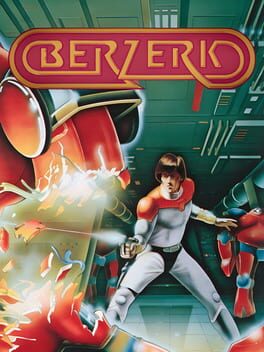
Berzerk
Maneuver your humanoid through the electrified mazes of robot filled rooms. You many kill off the first group of robots but initial success does not mean survival...future groups begin firing at your! Added danger lurks when Evil Otto enters. He can jump the maze walls and squash you if you linger too long!
| Released | 1980 |
|---|---|
| Developer | Stern Electronics |
| Publisher | Stern Electronics |
Platforms & ports
| System | Year | Region | Notes |
|---|---|---|---|
| ARC Arcade ★ original | 1980 | — | — |
Screenshots
5images — scroll sideways, click to enlarge
Video
History
Berzerk is a 1980 maze and shooter video game developed and published by Stern Electronics for arcades. The game involves a Humanoid Intruder who has to escape maze-like rooms that are littered with robots which slowly move towards and shoot at the Humanoid. The player can shoot at the robots to try to escape the room. Along with the robots, a smiley face known as Evil Otto appears to hunt down the player within each room.
The first game to be developed in-house at Stern, Berzerk was designed by programmer Alan McNeil. He slowly developed a game with robots at first, and then later added the walls and the Evil Otto character to expand on the gameplay. After the company was visited by a salesperson promoting a "speech chip", McNeil took the offer and incorporated digitized voices that taunt the player during gameplay and attract mode. Following Stratovox (1980), it was one of the earliest games to use speech synthesis.
Stern premiered the game at the Amusement & Music Operators Association (AMOA) exposition in Chicago in late 1980. It was released shortly thereafter, and sold around 15,000 units. Conversions to the Atari 2600 and Vectrex home consoles were released in 1982, followed by the Atari 5200 in 1984. They were generally received well by the video game press. The Atari 2600 version received a Certificate of Merit award for "Best Solitaire Videogame" from Electronic Games.
McNeil developed a 1982 sequel, Frenzy, with more variety. Berzerk directly influenced Robotron: 2084 (1982). The game appeared on various "best of" lists and articles from publications like Flux in 1995, GameSpy in 2002, and Retro Gamer in 2008.
Gameplay
Berzerk is described as both a maze and shooter game. The goal of Berzerk is to shoot as many robots as possible and escape a maze-like room. At the start of each room, the Humanoid appears in the middle of one of the four edges and can escape through the exits on a different side of the area.
The rooms are littered with robots that move slowly and occasionally shoot at the player. The robots can fire in eight directions. The player shoots in one of the eight directions the joystick is moved towards. The joystick also controls the Humanoid Intruder's movement. The player cannot move while firing. Bonus points are awarded when the robots in all of the rooms are destroyed. A smiley face known as "Evil Otto" will eventually come into the room from where the Humanoid entered and cannot be destroyed. Evil Otto can move through walls and follows the Humanoid Intruder while trying to defeat it. Being shot by the robots, touching a maze wall, or coming into contact with either Evil Otto or a robot will result in the player losing a life.
DIP switches are available in the arcade machine for the operator to adjust some gameplay elements. This provides options to allow the player to receive an extra life at 5,000 points, 10,000 points or not at all.
By 1981, two models of Berzerk existed. The first featured three different colored robots, with the yellow robots that do not shoot bullets, red robots that shoot one shot at a time, and white robots that shoot two shots at a time. The next model featured all the previous robots, as well as purple robots that shoot three or five shots at a time, yellow robots that shoot four shots at a time, and a white robot that shoots one very fast shot.
Development
Alan McNeil developed Berzerk for Stern Electronics. McNeil enjoyed games like Stratego and Mille Bornes when he was younger. He became interested in network-based video games through the PLATO computer system. After college, he made some games on his Sol-20 computer, like an adaptation of Chase, a game that originated on the Dartmouth Time-Sharing System which later appeared as a type-in listing in Creative Computing, Kilobaud Microcomputing, Dr. Dobb's Journal and David Ahl's book More BASIC Computer Games. How McNeil encountered Chase is unclear: while he remembered seeing the game in Byte, it never appeared as a type-in listing in that publication. McNeil found work at Dave Nutting Associates, where he programmed the coin-op sequels Boot Hill and Sea Wolf II and ported Gun Fight to the Bally Professional Arcade. Tired of working on ports and sequels, McNeil requested permission to create an original video game, but management refused to let him, citing his lack of game design experience. This resulted in McNeil seeking work outside the company.
McNeil found new work at Stern Electronics in 1979 with the promise that, after he fixed a problem on a Bally controller board, he could develop a video game. Stern was starting to get involved in video games, which led to McNeil doing the artwork, graphics design, programming and debugging of the game himself. He quickly developed a prototype of the game on his Tektronix development system. The first prototype was influenced by Chase. It had the theme of robots attempting to kill the player and the robots vanishing if they crashed into each other. He used Fred Saberhagen's series Berserker for the title of the game, as the novels are about robot war machines that are out to kill all biological life forms. He said in an interview that developing the concept for the game was simple, but described actually making the game as "drudge work".
McNeil wanted the average game to last about three minutes for a novice player. In his initial version, McNeil said he made the robots move too quickly, which caused the game to become "too hard, even with just six robots; the game favored the robots too much - they would crash into each other occasionally, but the average game time on one life was about six seconds - not good." He tweaked the robots' speeds and adjusted the number of bullets they could shoot as the player entered a new room. The walls in the rooms were initially not entirely random, which McNeil felt was not immersive. He altered the game so that rooms had a seed generator based on certain x and y co-ordinates within the code.
To incentivize a player to leave a room once the robots were defeated, McNeil created the "Evil Otto" character, a bouncing happy face. McNeil stated that he despised the happy-face icon and believed its associated phrase, "Have a nice day", was used by "people who didn't want you to have a nice day, but instead wanted to cover themselves in fake righteousness. So I showed it like it was: 'have a nice day while I beat you to death!'". He named the character after Dave Nutting Associates office manager Dave Otto, who enacted several office policies that annoyed the engineers.
During the game, the enemy robots speak audible threats, warnings, and insults whether a player fights or flees the room. McNeil said that the game originally had what he described as "pinball-type sounds", but this was changed when a salesman visited during development. The salesman was selling a "speech chip"; the chip was intended to assist people with visual impairments, but the company was trying to expand into toys and games, and, upon finding that the voice sounded very robotic, McNeil used it for Berzerk. The speech chip used custom hardware to make hisses and tones which could be assembled into words. McNeil kept the phrases short and applied them to the game to taunt players. He also included phrases for attract mode.
The last major addition was in the final month of production: making the game in color instead of black and white. As a black and white game, Berzerk was originally designed with translucent ink applied to the monitor screen to make it appear to be in color. To make the game truly colored, company engineers created a four-bit color overlay video layer.
== Release ==…
Adapted from Wikipedia , licensed under CC BY-SA 4.0. Text may have been shortened.