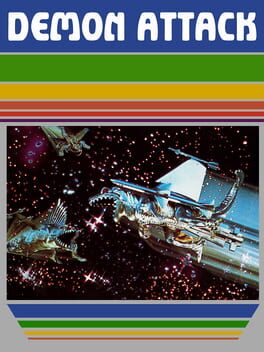
Demon Attack
Demon Attack is an arcade action game with gameplay similar to Space Invaders. You control a laser cannon at the bottom of the screen, and need to destroy wave after wave of brightly colored demons. The demons bounce around the screen in bizarre patterns, and try to destroy your cannon with bombs or lasers. When you shoot a demon, it will be replaced with another or will split into two smaller demons depending on which wave you are playing. When the required number of demons for the current round is finally destroyed, you can move on to the next, more difficult round.
| Released | 1982 |
|---|---|
| Developer | Imagic |
| Publisher | Tandy |
Platforms & ports
Screenshots
4images — scroll sideways, click to enlarge
Video
History
Demon Attack is a fixed shooter video game created by Rob Fulop for the Atari 2600 and published by Imagic in 1982. The game involves the player controlling a laser cannon from the surface of a planet, shooting winged demons that fly down and attack in different sets of patterns.
Fulop designed the game after leaving Atari, saying he was not properly reimbursed for his work on a port of Space Invaders. He co-founded the company Imagic in 1981 and began developing Demon Attack. It was the first game he developed that had a graphic artist, Michael Becker, who created eight-phase animations for the demons. Upon the game's release in 1982, it received positive critical attention for its graphics and gameplay and became one of the best-selling Atari 2600 games, and the best-selling game developed by Imagic.
Programmer Gary Kato created a port of Demon Attack for the Intellivision console which added a final boss mothership. The boss was similar in gameplay to the final boss in Phoenix (1980), a game Atari had exclusive console rights to. This led to Atari filing a suit against Imagic. A settlement was reached in January 1983, with Imagic being allowed to release Demon Attack for several video game consoles and home computers in the 1980s.
Gameplay
Demon Attack is set on a surface of a planet, when strange winged creatures float above, threatening the player. They attack, leading the player to retaliate by shooting at them with a laser cannon.
Matthew House of AllGame described the game as a fixed shooter. The players start with three lives, called bunkers in the game, which are displayed at the bottom of the screen. Each time the players are hit by enemy fire, they lose a bunker, and the game ends when all bunkers are depleted. The waves of enemies grow more complex as the game progresses, with wave five having enemies divide into two smaller enemies after being shot. Later waves have enemies that will dive towards the laser cannon.
The players can move left and right at the bottom of the screen to avoid enemies. The game offers different modes of play, including a Tracer Shot mode, which allows the player to guide lasers after they are shot. Two-player games can either be played competitively against each other or as a co-op mode. In the co-op mode, the two players alternate every four seconds on who controls moving and firing the ship's laser. In competitive mode, each player controls their laser cannon simultaneously with their own score and bunker count. If one player loses all their bunkers, the other player continues until their bunkers are also lost.
In the Intellivision version, the boss fight with the demon flagship named Pandemonium appears after three waves of enemies are defeated. It is destroyed by eroding its shield with laser shots and aiming for a small rotating wheel of vulnerability.
Development
Prior to working on Demon Attack, Rob Fulop worked at Atari developing sound effects for pinball machines as a summer job while studying electrical engineering at the University of California. Fulop's later projects included adaptations of arcade games such as Night Driver and Missile Command for the Atari 2600 and Space Invaders for the Atari 8-bit computers. He said that he expected a strong Christmas bonus from Atari based on how well Space Invaders had done commercially, but he only received a voucher for a free turkey dinner. Fulop then left Atari, and upon seeing how well Activision had been doing, he co-founded the company Imagic on July 17, 1981.
Fulop said that "I was angry at Atari and wanted to make something so good, they'd cry when they saw it. A lot of the best work is motivated by a desire to show someone what they've missed out on". This led to him designing Demon Attack. He said the game was modeled after Galaxian. The game took nine months to create. Demon Attack was the second original game Fulop had begun developing, as he had also worked on an original game at Atari that was never completed. The first complete version of Demon Attack only had one pattern of enemies repeated endlessly. Fulop focused on creating additional motions for the enemies to give them more of an organic movement pattern. It was the first game he developed that had a graphic artist, Michael Becker, who created eight-phase animation for the demons. Fulop later said that "I had to fight to keep the game in the lab for the last month, my mistake in finishing everything before polishing the motion—marketing was eager to ship it—I insisted on holding it back. It got quite heated".
Fulop only created the original game for the Atari 2600 and consulted on the Intellivision adaptation. Pat Ransil of Imagic said that the Atari 2600's hardware permitted smooth and easy movement across the screen horizontally, so Fulop designed the enemy demons to move on a mostly horizontal plane. Gary Kato designed the Intellivision version of the game, which let the demons move in any direction, as the system allowed for that in an easier way. Kato's version of Demon Attack features a final boss and less colorful enemies than the Atari 2600 version, but included other visual elements such as displaying the Moon's surface and having Earth in the background. Kato said he could not make the game look like the Atari version on the Intellivision, and credited Becker, who he described as Imagic's "head art guy", for creating the appearance of the boss enemy Pandemonium. Kato stated "when my eyes saw this, my mouth was hanging open, as soon as people started coming into work, I rushed back down and said...I have to have this in the game!" Kato concluded that if any art looked good in the game, it was created by Becker, while anything which did not look strong was his own. Fulop has said he worked closely with David Johnson on the Atari Computer version of the game, but that he generally just wrote three-page documents for the other versions on how the algorithms of his code functioned. There was no shared code for the later ports. Johnson would also code the Magnavox Odyssey 2 version of the game. A similar mother ship appears in the Commodore 64 version of the game.
Release
Demon Attack was released in March 1982 for the Atari 2600 along with two other Imagic games: Star Voyager and Trick Shot. Becker created the cover art from model toys painted silver and blue. It was released for the Intellivision in October 1982.
By the end of 1982, the Atari 2600 version of Demon Attack was the third highest selling console game of the year, only being beaten by Pitfall! and Pac-Man. The game was also released for other consoles such as the Intellivision and Magnavox Odyssey 2. The Intellivision version was the 9th highest-grossing game of 1982. The Magnavox Odyssey 2 version of Demon Attack, which released in 1983 in both North America and Europe, was the first cartridge for the system by an independent publisher. It was also ported to several home computers, including the TI-99/4A, the Atari 8-bit computers, Commodore 64, VIC-20, TRS-80 Color Computer and IBM PCjr. The game was retitled Super Demon Attack for its release on the TI-99/4A computer and a port of the Odyssey 2 version called Demon Attack Plus when it was released for the Philips Videopac+ G7400 in France. Demon Attack was included in the Activision Anthology compilation, but was removed for the Game Boy Advance release.
Kato's version of Demon Attack for the Intellivision features a final boss named Pandemonium that is similar to the boss in the arcade game Phoenix (1980). Fulop had played Kato's version of the game and disliked the addition of the boss. He said: "That, to me, was totally stupid. I mean, it's exactly the same game [as Phoenix]". Atari had the exclusive rights to produce Phoenix for home consoles and filed suit against the company Imagic, believing that the Intellivision version of Demon Attack was too derivative of the arcade game. A settlement was reached in January 1983, with Imagic still being allowed to release Demon Attack. When asked about the legal issues between Atari and Imagic related to Demon Attack, Fulop said he "kept out of a lot of that. It was basically a silly hustling and political thing. I think I went to one deposition, that was it [...] No one really cared too much about it". Demon Attack went on to become the best selling Imagic game.
== Reception ==…
Adapted from Wikipedia , licensed under CC BY-SA 4.0. Text may have been shortened.