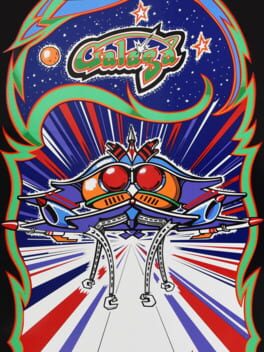
Galaga
The objective of Galaga is to score as many points as possible by destroying insect-like enemies. The player controls a starfighter that can move left and right along the bottom of the playfield. Enemies swarm in groups in a formation near the top of the screen, and then begin flying down toward the player, firing bombs at the fighter. The game ends when the player's last fighter is lost, either by colliding with an enemy or one of its bullets, or by being captured. Galaga introduces a number of new features over its predecessor, Galaxian. Among these is the ability to fire more than one bullet at a time, a count of the player's "hit/miss ratio" at the end of the game, and a bonus "Challenging Stage" that occurs every few levels, in which a series of enemies fly onto and out of the screen in set patterns without firing at the player's ship or trying to crash into it. These stages award a large point bonus if the player manages to destroy every enemy. Another gameplay feature new to Galaga is the ability for enemies to capture the player's fighter. While the player is in control of just one fighter, a "boss Galaga" (which takes two shots to kill) periodically attempts to capture the fighter using a tractor beam. If successful, the fighter joins the enemy formation. If the player has more lives remaining, play resumes with a new fighter. The captured fighter flies down with the enemy that captured it, firing upon the player just like normal enemies, and can be shot and destroyed. The player can free the fighter by destroying the boss Galaga while in flight, causing the captured fighter to link up with the player's current fighter, doubling his or her firepower but also making a target twice as large. Galaga has an exploitable bug that can cause the attackers to stop firing bullets at the player, due to a coding error. In addition, similar to the famous "Split-Screen bug" in Pac-Man, a bug exists in Galaga in which the game "rolls over" from Level 255 to Level 0. Depending on the difficulty setting of the machine, this can cause the game to stall, requiring that the machine be reset or power-cycled in order to start a new game.
| Released | 1981 |
|---|---|
| Developer | Namco Limited |
| Publisher | Midway |
Where to buy
Prices are cached and may be out of date — check the storefront before buying.
Platforms & ports
Screenshots
3images — scroll sideways, click to enlarge
Video
History
Galaga is a 1981 fixed shooter video game developed and published by Namco for arcades. It was released by Midway Manufacturing in North America. It is the sequel to 1979's Galaxian, and the second game in the Galaxian series. Controlling a starship, the player is tasked with destroying the Galaga forces in each stage while avoiding enemies and projectiles. "Boss Galaga" enemies can capture a player's ship via a tractor beam, which can be rescued by another ship to give the player a "dual fighter" with additional firepower.
Shigeru Yokoyama led development with a small team. Initial planning took about two months to finish. Originally developed for the Namco Galaxian arcade board, it was instead shifted to a new system as suggested by Namco's Research and Development division. Inspiration for the dual fighter mechanic was taken from a film that Yokoyama had seen prior to development, in which a ship was captured using a large circular beam. The project became immensely popular around the company, with Namco's president Masaya Nakamura even taking interest.
Although early location tests were unsuccessful, Galaga went on to become one of the most successful titles of the golden age of arcade video games, routinely appearing on Japanese and American arcade charts through 1987. It was acclaimed by critics for its gameplay, innovation, addictive nature and improvements made over its predecessor, and is widely regarded as one of the greatest video games of all time. Several home ports were released for a multitude of platforms, including the MSX, Atari 7800, and NES, alongside releases on digital distribution platforms such as Xbox Live Arcade and appearances in many Namco compilations. It was followed by Gaplus in 1984.
Gameplay
Galaga is a fixed shooter. The player controls Gyaraga at the bottom of the screen, which must prevent the Galaga forces from destroying all of mankind. The objective of each stage is to defeat all of the Galaga aliens, which will fly into formation from the top and sides of the screen. Similar to the previous game, Galaxian, aliens known as "Gorgs" will dive towards the player while shooting down projectiles; colliding with either projectiles or aliens will result in a life being lost.
Atop the enemy formation are 4 large aliens known as "Gorg the Boss Galaga", which take 2 shots to destroy (like "Galaxian Flagships" seen in 1979's Galaxian, which take 1 shot to destroy). These enemies can use a tractor beam to capture the player's ship, returning with it to the top of the formation and costing the player a life. Should additional lives remain, the player has an opportunity to shoot down the Boss Galaga holding the captured Gyaraga. Shooting him down as he dives towards the player will result in the captured Gyaraga being rescued, and it will join the player's ship, transforming it into a "dual-fighter" with additional firepower and a larger hitbox. However, destroying Gorg with a captured ship while it's in formation will instead cause the fighter to turn against the player and act as an enemy. The Gyaraga will return in a later level as part of the formation.
Some enemies have the ability to morph into new enemy types with different attack patterns, including the Galaxian Flagship from Galaxian, the Scorpions, and the Midori (which resembles the Spy Ship from 1981's Bosconian). Stages are indicated by emblems at the bottom-right of the screen. Enemies can become more aggressive as the game progresses, increasing their number of projectiles and diving down at a faster rate. The third stage and every 4th thereafter is a bonus stage, where the aliens fly in a preset formation without firing at the player.
Bug
In the original arcade version, if a player completes stage 255 (the maximum unsigned 8 bit integer), the next stage would be announced as stage zero, and depending on the dip switches on the arcade, the game resets, plays levels incorrectly, locks up, or plays at the wrong difficulty. This is known as a kill screen.
Development
Galaga was created by Japanese developer Shigeru Yokoyama, a long-time veteran of Namco. Namco's first big video game hit in arcades was Galaxian (1979); the game's success led Namco to produce a large number of Namco Galaxian arcade boards to keep up with demand. By the early 1980s the game was becoming harder to sell, so to help clear out inventory, Yokoyama was tasked with creating two new games that could run on the Namco Galaxian board. The first of these was King & Balloon (1980), a fixed shooter that is cited as the first video game to incorporate speech. The second game was instead made for newer hardware as suggested by Namco's Research & Development division. This new arcade board was named the Namco Galaga and was used in games including Bosconian (1981) and Dig Dug (1982). Although Yokoyama was not given explicit instructions to make a shooting game, management expressed desire for him to make a game similar to Galaxian. Initial planning for the project took two months.
The idea for the dual fighter stemmed from Yokoyama wanting to create enemies with different attack styles. The tractor beam emitted by the Boss Galaga was inspired by a film in which a character's ship was captured by a circling laser. Yokoyama incorporated this idea into Galaga, whereby an enemy could capture the player's ship with a beam and the ship would need to be rescued. Originally, rescuing a captured ship would award the player an extra life, but this was soon changed to having it fight alongside the player. This idea proved to be a problem at first; due to hardware limitations, the game could only display a limited number of sprites, resulting in the dual-fighter being unable to shoot any more missiles. As a workaround, Yokoyama made a 16x16 sprite for the ship and a 16x16 sprite for the bullets, reducing the total sprite count by two.
Inspired by the intermissions in Pac-Man (1980) and bonus stages in Rally-X (1980), Yokoyama added a special bonus level. While planning, lead programmer Tetsu Ogawa informed him of a bug whereby enemies would simply fly off the screen instead of moving into formation. Ogawa expressed interest in incorporating the idea into the game, leading to the inclusion of the Challenging Stages. Enemies originally flew in one type of pattern, with more being added to increase replay value. Graphic designer Hiroshi Ono designed many of the sprites, including the player's ship and the Boss Galaga alien.
Prior to location testing, the team focused on designing the instruction card, a sheet of paper that showed how the game was played. The text was done by the planners, while the actual design was handled by a graphic artist. The card originally showed the control layout and the basics of the game, which was stripped early on for being too boring. Yokoyama suggested that the card instead show off the dual fighter mechanic, as a means to draw in players. The team kept bringing in designs to Namco president Masaya Nakamura, who continued to reject them until he ordered the team to simply make it in front of him.
The team was allowed to set their own deadlines, due to Namco's then-laidback corporate structure. Feedback on the project was given by Nakamura and other employees, including Pac-Man creator Toru Iwatani. Despite the game's immense popularity around the company, early location tests failed to meet expectations due to players being able to progress a long way with only one coin, thus generating low income. Although Yokoyama stated that the game's popularity could still generate income, Namco executives instructed the team to increase the difficulty level. Galaga was released in Japan in September 1981; Midway Manufacturing, who had previously licensed Galaxian, released the game in North America in November of that year.…
Adapted from Wikipedia , licensed under CC BY-SA 4.0. Text may have been shortened.