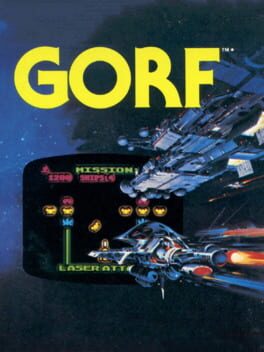
Gorf
Gorf actually consists in the Arcade version of five different types of space shooters. The first one ist basically is a Space Invaders clone. In the second one a formation of space ships is hovering at the top of the screen while single space ships will disengage from the formation and dive down at you. The third variant is a Glaxian clone and only available in the Arcade version. In the fourth mini-game the enemy will come out of a circular hyperspace field and attack you. After having destroyed four of your attackers the game proceeds to the fifth game stage. Here a huge mothership is dropping bombs at you from the top of the screen. You defeat the mothership with a well placed projectile hitting it between its two major sections. After that the game starts from the gebinning on a higher difficulty level.
| Released | 1981 |
|---|---|
| Developer | Dave Nutting Associates |
| Publisher | 3D Stooges Software |
Platforms & ports
Screenshots
7images — scroll sideways, click to enlarge
History
Gorf is a 1981 fixed shooter video game developed by Dave Nutting Associates and published by Midway Manufacturing for arcades. It features five distinct levels, the first of which is based on Space Invaders and another on Galaxian. The game makes use of synthesized speech for the Gorfian robot which taunts the player, powered by a speech chip. Gorf allows the player to buy two additional lives per quarter before starting the game, for a maximum of seven lives.
The home ports omit the Galaxians stage because Japanese developer Namco (now Bandai Namco Entertainment) owns the rights to the Galaxian franchise.
Gameplay
Gorf is a fixed shooter in which the player takes control of an unnamed starship from the Interstellar Space Force with a mission to prevent the iron-fisted Empire of GORF from conquering Earth. The ship is capable of moving freely in all directions around the lower third of the screen under the control of a joystick. This was a departure from older vertically oriented linear shooters, including Space Invaders and Galaxian, which allowed only horizontal movement of the player's ship controlled by left and right buttons. At the time, the joystick input and two-dimensional movement were still unusual enough that contemporary video game guides noted them as distinctive features of Gorf.
Gameplay consists of five distinct missions; every mission presents its own unique playstyle, but the central goal of each is to destroy all enemies. Successfully completing all five missions loops the player back to the first mission and also increases the player's rank, which represents the current difficulty level of the game. Gameplay continues until the player loses all of their lives.
Before starting a new game, players can buy up to seven additional lives by purchasing more credits; an extra life is also granted after clearing the first five missions. Unlike similar games where the player can only shoot their weapon after an existing shot has disappeared from the screen, the ship is equipped with a laser cannon capable of firing a single vertical shot (called a "quark laser") at any time, although doing so causes the previous shot to disappear.
Players can advance through the ranks of Space Cadet, Space Captain, Space Colonel, Space General, Space Warrior and Space Avenger, which increases the speed and difficulty of the game and introduces more enemy patterns. Depending on the version, the player's current rank is displayed via a series of integrated lit panels on the cabinet.
Missions
Astro Battles: A clone of Space Invaders; it is the only mission that takes place on Earth instead of space. 24 enemies attack in the classic pattern set by the original game; however, the player is protected by a parabolic force field that switches off temporarily when the player's shots pass through it and is gradually worn away by enemy fire.
Laser Attack: The first mission set in space, where the player must battle two formations of five enemies. Each formation contains three yellow enemies that attempt to dive-bomb the player, a white gunner that fires a single laser beam, and a red miniature version of the Gorf robot.
Galaxians: As the name implies, this mission is a clone of Galaxian, with the key differences being the number of enemies and the way they fire at the player. Gameplay is otherwise similar to the original game.
Space Warp: This mission places the player in a sort of wormhole, where enemies fly outward from the center of the screen and attempt to either shoot down or collide with the player's ship. It is possible to destroy enemy shots in this level.
Flag Ship: The Flag Ship is protected by its own force field, similar to the one protecting the player in Mission 1, and it flies back and forth firing at the player. To defeat it, the player must break through the force field and destroy the ship's core. As with the alien ship in Phoenix, the bottom of the flag ship must be blasted away to expose the vulnerable core. If a different part of the ship is hit, the player receives bonus points, and the part breaks off and flies in a random direction, potentially posing a risk to the player's ship. When the player successfully hits the core, the Flag Ship explodes in a dramatic display, the player advances to the next rank, and play continues on Mission One (Astro Battles), with the difficulty increased. Later encounters with the Flag Ship on higher ranks include additional enemies during the mission.
Development
Background and pre-production
Gorf was developed by Jamie Fenton of Dave Nutting Associates (DNA). DNA had become Research and development consultants for Midway Manufacturing at the beginning of the 1970s, and they had developed several arcade games such as Gun Fight (1975), a reworking of Taito's game Western Gun. Around this period, Nutting was working on a light gun-based game where the player would attempt to shoot a character he initially christened "Gorf". The game eventually developed into Desert Gun (1977).
Fenton had worked with DNA initially to work on pinball machines. She was a co-creator on some early arcade games such as The Amazing Maze Game (1976) and 280 ZZZAP (1977) and led the team who created an early video game console, the Bally Astrocade. Some of the custom integrated circuits for the system were manipulated and later re-used in Gorf. This included customized LSI Framebuffer chip sets. These chips allowed for Exclusive or writing of images which allowed objects on the screen to pass in front of or behind other objects and backgrounds.
Some chips allowed for digitized speech that taunted the player with phrases like "Long live Gorf!" and "Prepare for annihilation, Space Cadet!" The speech originated in chips designed for the Bally console. Fenton recalled that "Quite a few were on the blue end of the spectrum but they still had obscenity laws back then! They had to be clean but still annoying enough to serve their purpose. My favourite? "Your end is near". That gets a lot of double entendres."
Gorf began as a video game adaptation of the film Star Trek: The Motion Picture (1979). Fenton was initially excited on the idea of an adaptation, but abandoned the idea after reading the script for the film, and deciding that they could not draw a great idea for a video game from the script. She only used some leftover elements such as the boss flagship in Gorf resembling the USS Enterprise.
Level design
Fenton took over a year to develop the game with most of Gorf from home, to avoid interacting with her boss in the office. During this period in video games, most games levels required players just to do the same task but in faster time, less resources, or with more enemies. Influenced by director D.W. Griffith, Fenton felt that Gorf should be like "cutting from one scene to another" and desired to make a multi-episodic game.
She created three original levels, and two that borrowed from other arcade games. As Midway Manufacturing had arrangements with the Japanese companies Taito and Namco to distribute their games Space Invaders (1978) and Galaxian (1979) in the United States, they took creative license and used elements from each game as different-styled levels in Gorf. These scenes have slight variations on the gameplay in both games, such as the group of enemies from Galaxian swooping en masse towards the players space ship. The first level features a blue screen to represent Earth. It uses the Space Invaders elements is titled "Astro Battles". Fenton explained that the name change was done in order to "not promote that brand too much". The third level Galaxians with its extra s in its title attributed to being a misspelling on Fenton's part.
The boss fight with the Gorfian flagship was inspired by the trench run scene in Star Wars (1977). Fenton joked that "back then, people would shamelessly use other people's ideas."
The cabinet art was done by David Moore of Advertising Posters in Chicago.
Release
Gorf field tested alongside Pac-Man (1980) in the United States. Gorf was published by Midway Manufacturing and distributed to arcades in the United States in February 1981.
George Gomez, who joined Midway after graduating in 1978, began work with other Midway engineers on controls and cabinets for the company, including the controller for Gorf. The game was released in three different sizes of Midway model arcade cabinets. The first was their standard model that featured graphics on the outside of the cabinet, the second being a smaller scaled model with a walnut finish made for saving space in an arcade, and the last being a cocktail table styled cabinet. At the time, the Gorf controller was unique as it had the fire button built into the pistol grip. Fenton stated that the controller was derived from a B-1 bomber design Dave Nutting’s team had previously produced for the defense industry.…
Adapted from Wikipedia , licensed under CC BY-SA 4.0. Text may have been shortened.