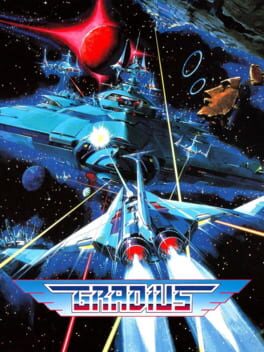
Gradius
One of the defining characteristics of the Gradius series is the use of a "power meter." The power meter is powered by a power-up item, whose purpose, when collected, is to move a highlight to the next power-up on the power meter. When a power-up that the player wants becomes highlighted, he or she may activate it, also causing the highlight to reset.
| Released | 1985 |
|---|---|
| Developer | Konami |
| Publisher | Konami |
Where to buy
Prices are cached and may be out of date — check the storefront before buying.
Platforms & ports
Screenshots
5images — scroll sideways, click to enlarge
Video
Story
Gradius, our mother planet. Bacterian, a cluster of stars located in subspace, has invaded this dazzling planet and exposed it to a series of vicious battles.
Threatened with extinction in the face of such an onslaught, the planet Gradius decides to deploy its final hope: the super-dimensional fighter Vic Viper.
Its destination is the enemy fortress of Xaerous.
The only way to put an end to this conflict is to plunge deep into the enemy's stronghold and destroy the core that lies at its center.
Prepare to launch!
And so, Vic Viper takes off into the vast blackness of space.
History
Gradius is a 1985 horizontally scrolling shooter video game developed and published by Konami for arcades. It is the first installment in the Gradius series. The player maneuvers a spacecraft known as the Vic Viper that must defend itself from the various alien enemies. The game uses a power-up system called the "power meter", based upon collecting capsules to acquire additional weapons.
The arcade version of Gradius was initially released internationally outside Japan under the title of Nemesis, but subsequent home releases have since used the original title. During development, it had the working title Scramble 2, as it was originally intended to be a follow-up to Konami's earlier shooter Scramble (1981). Home versions were released for various platforms, such as the Nintendo Entertainment System, the MSX home computer, and the PC Engine. It was a major success in 1986, becoming the year's highest-grossing arcade game in London and one of Japan's top five table arcade games, while the Famicom port sold over a million copies in Japan that year. Nintendo released the NES version in arcades for the Nintendo VS. System as VS. Gradius and PlayChoice-10 in November 1986.
Gradius was critically acclaimed for its gameplay and at the time unique power-up system. Along with Namco's Xevious, it is cited as being one of the most important shooter games, having paved the way for many similar games to follow.
Gameplay
The player controls the trans-dimensional spaceship Vic Viper and must battle waves of enemies through various environments. The game became synonymous with the phrase, "Destroy the core!", as the standard of boss battles in the Gradius series involved combat with a giant craft, in the center of which would be situated one to several blue colored spheres. These bosses were designed in such a way that there was a straight passage from the exterior of the giant craft leading directly to one of these cores. The player must fire shots into this passage while avoiding attack patterns from weapon emplacements on the body of the boss. However, small but destructible walls are situated in this passage, impeding the bullet shots from damaging the core, and must be whittled away by repeated well-placed shots. In a way, these tiny walls represent the boss' shielding gauge until its core is finally vulnerable to attack. Some bosses can regenerate these walls. When the core has sustained enough hits, it usually changes color from blue to red, indicating that it is in critical condition and its destruction is imminent. Upon the destruction of a core, a piece of the boss may be put out of commission, seeing that it is no longer powered by a core, or if all of the cores are destroyed, the entire boss is defeated and explodes. Cores are not present on the more organic bosses of Gradius. Such bosses have weak spots in places such as a mouth, head or eye.
When gameplay begins, the Vic Viper is relatively slow and has only a weak gun. This level of capability is generally insufficient for engaging all but the weakest single-hit enemies, but the Vic Viper can gain greater capabilities by collecting and using power-up items. While most arcade games utilize distinct power up-items that each correspond to a specific effect on the player character, Gradius has a single power-up item. The effect of this power-up item is to advance the currently selected item in a power-up menu that appears at the bottom of the screen. When the desired power-up is highlighted, the player can obtain it by pressing the power-up button, returning the menu to its initial state in which no power-up is highlighted.
Development
Gradius was the creation of Konami game designer Machiguchi Hiroyasu, and it was the first video game he publicly released. Hiroyasu joined the company in the early 1980s, as a programmer, at a time when Konami was trying to transition from being a producer of medal machines to a videogame developer. Konami assigned him to a small team with the task of producing a game that could establish the company in the videogame market. He asked the team what kind of game they'd like to work on, and they replied that they wanted to make another shooting game. The shoot 'em up genre had seen a resurgence at the time with Namco's Xevious, and the goal of this project became to make a shooter that could surpass Xevious. The project was at first intended to be a follow-up to Konami's earlier game Scramble (1981); it was titled Scramble 2 and reused many of Scramble's materials and game mechanics.
Development of Gradius lasted for about a year, a time filled with anxiety for the production team due to a lack of confidence in creating their first game. Members of the project came up with ideas that were then tested on the arcade monitor to see if they worked. While designing the Option satellites, the team tested over 20 different movement patterns which were whittled down through the process of elimination. The game was produced for the Konami Bubble System 16-bit arcade hardware. Hiroyasu wanted the game to have a visually distinct world with unique enemies and locations, which was something relatively uncommon for shooters at the time. Inspiration for mechanics and story were derived from films such as Star Wars: A New Hope and Lensman, with the Laser weapon being directly taken from those in Lensman. The idea for a power-meter mechanic stemmed from the team's desire to give players the freedom to select whichever weapons they pleased. Early versions had the player collecting individual pick-up icons, which were cut for not being "satisfying" enough; it was instead replaced with a selection bar where players collected capsules to allow access to other weapons, an idea based on the function keys on a keyboard. The Moai enemies were added to pay homage to Xevious and its Nazca lines as well as giving the game a sense of mystery.
Releases
Arcade
Gradius was first released in Japan for Konami's Bubble System, an arcade board which allowed operators to change the software through the use of proprietary "Bubble Software" cartridge media based on magnetic bubble memory. The game was distributed as a standard printed circuit board in North America and Europe under the title of Nemesis. The North American version of Nemesis features a considerably increased difficulty compared to the Japanese and European version. To balance this, the game spawns a fleet of orange enemies when the player loses a life to provide as many power-up capsules as possible to recover as many upgrades as possible. Also the North American version presents a continue feature (but only for three times). The title screen was also updated, showing an in-game reproduction of the promotional artwork behind the logo.
The original Gradius is also included in various compilations such as Gradius Deluxe Pack for the PlayStation, Sega Saturn and Microsoft Windows, and Gradius Collection for the PlayStation Portable. Hamster Corporation released the game as part of their Arcade Archives series for the PlayStation 4 in 2015 and Nintendo Switch in 2020. This particular version was included by Konami in their Arcade Classics Anniversary Collection, released in 2019 for the Nintendo Switch, PlayStation 4, Xbox One and Windows.
Famicom/NES
The first home conversion of Gradius was released for Nintendo's Famicom console on April 25, 1986, in Japan. Due to the hardware limitations of the Famicom, many of the level designs were simplified (the Moai stage, for example, lacked the vertical scrolling present in the arcade game), and the maximum amount of options that the player can upgrade to was reduced from four to two. This version added a cheat code that could be entered while the game was paused that granted the player's ship almost all the power-ups. This code appeared again in many later Konami games such as Contra and Life Force, ultimately becoming known as the Konami Code. The international version for the Nintendo Entertainment System was released in North America in December 1986. It was the first NES game to be released by Konami in the region and, unlike the original arcade game, the title was kept unchanged between regions. It was re-released as part of the Nintendo Classics service on September 19, 2018.
The NES version was made available in arcades as a Nintendo VS. System board (under the title of VS. Gradius) and as a PlayChoice-10 cartridge. VS. Gradius was distributed to arcades by Nintendo. This version was released by Hamster Corporation as part of their Arcade Archives series for the Nintendo Switch and PlayStation 4 in 2019, distinct from their release of the original arcade version years prior.…
Adapted from Wikipedia , licensed under CC BY-SA 4.0. Text may have been shortened.