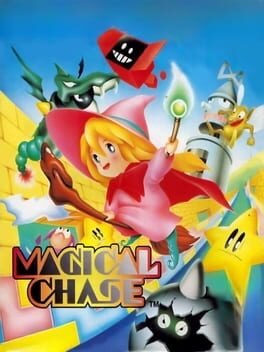
Magical Chase
Ripple is a student of magic, and her teacher is a terrifying witch. Ripple is particularly afraid of her teacher right now, because she's just broken a promise she made to the witch: Ripple took a peek inside the forbidden book Sleeping Demons! No sooner had she opened the cover then out jumped six demons, all of which raced away! Unless she can catch all six demons and get them back inside the book, the witch will turn Ripple into a frog for breaking her promise! So Ripple sets off on her quest with her two Elf-Star friends, Topsy and Turvy. Good luck, Ripple!
| Released | 1991 |
|---|---|
| Developer | Quest |
| Publisher | Turbo Technologies |
Platforms & ports
| System | Year | Region | Notes |
|---|---|---|---|
| WIN Windows | 1998 | — | — |
Screenshots
6images — scroll sideways, click to enlarge
Video
History
Magical Chase is a horizontal-scrolling shooter video game developed by Quest Corporation for the TurboGrafx-16. It was published by Palsoft in Japan on November 15, 1991, and by Turbo Technologies Inc. in North America in July 1993. A version for Microsoft Windows was released in 1998, followed by a version for the Game Boy Color (GBC) in 2000. The plot follows Ripple, an apprentice witch, accompanied by her star maiden friends Topsy and Turvy, on a quest to retrieve the demons she accidentally released from a forbidden book. The player controls Ripple, fighting enemies and avoiding obstacles, while collecting crystals to purchase items in shops.
Magical Chase was created by the same Quest staff that would later work on Ogre Battle, Tactics Ogre, and Final Fantasy Tactics. It was designed by art director Hiroshi Minagawa. The team wanted to create a shooter due to the popularity of the genre at the time, but they also wanted something unique and to explore how far they could go with the PC Engine, so production took a long time. The soundtrack was composed by Hitoshi Sakimoto and Masaharu Iwata.
Magical Chase received generally favorable reception from critics, with praise for the graphics, music, gameplay, and lack of slowdown. Some publications felt the presentation was lacking and the controls for the stars could be frustrating, while criticism focused on its short length. Retrospective commentary for the game has been generally favorable, and the North American release has become an expensive collector's item.
Gameplay
Magical Chase is a horizontal-scrolling shooter game. The story revolves around Ripple, a mischievous apprentice witch at a magic school. One day, Ripple's teacher asks her to stay alone at school. However, Ripple breaks the promise she made by opening a forbidden book called Sleeping Demons; in doing so, she accidentally releasing several sealed demons that escape into the outside world. Remembering that her teacher would turn her into a frog if she disobeyed, Ripple, along with her star maiden friends, Topsy and Turvy, embarks on a quest to return the demons back to the book.
The player controls Ripple, fighting enemies and avoiding obstacles. Topsy and Turvy fly around Ripple as support, providing additional firepower. The player can adjust the firing direction and the position of the stars. These also act as shields, protecting Ripple from bullets fired by smaller enemies. Defeated enemies drop lollipops and cakes to refill health. Enemies also drop collectible crystals of varying colors and values, which serve as currency in shops.
Throughout each stage, floating shops run by the pumpkin vendor Halloween Jack appear and are accessible by the player. In the Game Boy Color version, the vendor is a girl. There are nine magic attacks that can be bought for Ripple, including a rapid shot, a triple shot, a scatter shot, bouncing rings, wave beams, bubbles, and homing shots. Ripple has three special magic spells that can be stocked up to six times and saved for use throughout the game. These include health restorers, a single-use zapper that destroys all enemies and their bullets, and a power-up that increases the offensive and defensive attributes of the stars. Topsy and Turvy can also be powered up with two magic attacks. Other items include a speed regulator, a medicine that restores full health, a fruit that extends Ripple's initial maximum health by one, and single-use elixirs that restore health upon depletion. However, the shop does not appear during the last stage.
Each stage has a mid-boss and a boss. There are a total of six stages, called seals. If Ripple's health runs out, the player can start over or continue from the beginning of the last stage reached with the last weapon acquired. There are three difficulty levels: Breeze (easy), Bumpy (normal), and Rough (hard). In Breeze, only the first three stages are playable, while in Rough, enemy attacks are stronger. In the Game Boy Color version, the highest difficulty level is unavailable, and hint screens are added instead.
Development
Magical Chase was the first PC Engine game from Palsoft, a Japanese third-party publisher for the PC Engine and Sega Mega Drive. The game was developed by the same team at Quest Corporation that would later work on Ogre Battle, Tactics Ogre, and Final Fantasy Tactics. It was designed by Hiroshi Minagawa, who also served as art director. The Quest staff wanted to create a shooter, as shooters were popular at the time, but they also wanted to do something unique within the genre. When development began, the team had specific ideas for the characters, but the enemies were still undecided. Production of the game took a long time, as the staff wanted to explore how far they could push the PC Engine and were meticulous about details such as timing the appearance of enemies with the background music in the third and fifth stages.
The music for Magical Chase was scored by Hitoshi Sakimoto and Masaharu Iwata. It was Sakimoto's first work on the PC Engine and with Quest, having joined the company at Iwata's request. Sakimoto designed a sound driver, as he wanted to test through trial and error what kind of audio the PC Engine's sound hardware could produce, and the driver was constantly updated to create better sounds. Sakimoto acknowledged that creating the soundtrack was challenging due to hardware limitations, but he felt it was well-suited to the game. Iwata considered it the shooter for which he liked composing music the most, as he encountered no issues with the PC Engine hardware and thoroughly enjoyed composing music for "such a good game". In 2013, SuperSweep released a CD album in Japan containing the game's original soundtrack, as well as arrangements and prototype songs.
Release
Magical Chase was first announced for the PC Engine at the 1991 Consumer Soft Group (CSG) trade show; an August 1991 release date was planned. The game was shown at the 1991 Tokyo Toy Show, but its release was rescheduled for October 1991. It was released in Japan by Palsoft on November 15, 1991, in small quantities, and sold out that same day. Palsoft received requests and made efforts for a re-release, but it never materialized. Due to its limited availability on the market, the first edition became a premium item. In 1993, PC Engine Fan announced a limited re-release of the game as a commemorative project for the magazine's fifth anniversary. The initial deadline for pre-orders was July 31, 1993; however, the deadline was extended to August 9, 1993, due to overwhelming consumer demand that exceeded the publication's expectations. The reissue, dubbed the "Fan Edition," was distributed on September 30, 1993, via mail only. It came in a white case and featured a sticker reflecting its association with PC Engine Fan.
In North America, the game was showcased for the TurboGrafx-16 at the 1992 Summer Consumer Electronics Show and initially scheduled for release in November 1992, but was delayed until January 1993. It was released in July 1993 by Turbo Technologies Inc. (T.T.i.), a joint venture formed by NEC and Hudson Soft in 1992 to relaunch the TurboGrafx-16, which was struggling in the North American market. GamePro wrote that the game was released in April 1993. The American version features graphical changes compared to the original Japanese version, such as several redrawn sprites, as well as an altered foreground and background in the first stage. Because it was released in limited quantities near the end of the console's lifespan, Magical Chase became one of the rarest and most expensive TurboGrafx-16 titles, commanding high prices on the secondary collecting market.…
Adapted from Wikipedia , licensed under CC BY-SA 4.0. Text may have been shortened.