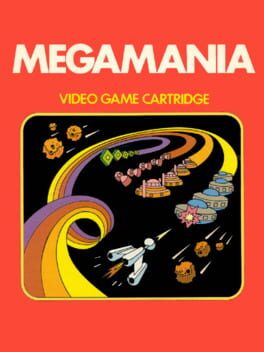
Megamania
In Megamania, the gameplay resembles that of Space Invaders. Rather than being aliens or spaceships, however, the enemies in this game are various objects such as hamburgers, bow ties, and steam irons. The object is to shoot them down before the energy bar at the bottom of screen is depleted, all while avoiding the oncoming enemies and their own projectiles attacks. Each of the enemies fly in select patterns and as soon as they hit the bottom of the screen, they re-appear at the top until shot by the player. The player's spacecraft depicted in the game is a cross between the U.S.S. Enterprise and Klingon battlecruiser from the Star Trek universe. Gameplay-wise and in terms of graphics, MegaMania bears a very strong resemblance to Sega's 1981 arcade title "Astro Blaster". Both games feature nearly identical patterns of approaching enemies with the player relying on an "Energy" meter. Also, the player's ship bears a remarkable similarity in both games. When Megamania was originally sold, anyone who scored above 45,000 points could send Activision a picture of their screen and become an official Megamaniac. They also would receive an Official Megamaniac emblem.[2] If a player exceeds a score of 999,999 the game ends.
| Released | 1982 |
|---|---|
| Developer | Activision |
| Publisher | Activision |
Platforms & ports
Screenshots
3images — scroll sideways, click to enlarge
Video
History
Megamania is a fixed shooter video game developed by Steve Cartwright for the Atari 2600 and published by Activision in 1982. In the game, a pilot of an intergalactic space cruiser has a nightmare where his ship is being attacked by food and household objects. Using the missile launcher from their space cruiser, the pilot fends off the attackers. The game was later released for the Atari 5200 and Atari 8-bit computers.
Cartwright initially found inspiration for Megamania's gameplay from the arcade game Astro Blaster (1981). After completing a variation of the game, the team at Activision felt it needed a different form to separate itself from various space shooter games on the market, eventually leading to Activision's ad agency developing the food-induced nightmare theme. The game took nine months for Cartwright to develop.
Initial response to Megamania had critics split with early reviews complimenting the graphics and varied movement of the enemies, while others felt it was another game in an already oversaturated field of games influenced by Space Invaders (1978). The game received the "Most Humorous Home Arcade Game" at the 4th annual Arkie Awards, and in 1984 Video and Computer Gaming Illustrated declared Megamania as the best Atari 2600 game.
Gameplay
In Megamania, the player is a pilot of a machine referred to as both an intergalactic space cruiser and a mobile blaster. After a day of work, the pilot gorges themself on food ranging from ice cream to pizzas and begins to hallucinate. At home after falling asleep, the pilot finds themself in a nightmare being attacked by various food and household objects such as hamburgers, steam irons and bow ties. The player must control their fleet of mobile blasters that are under attack from these objects.
Megamania can be played with one player, or two players taking turns. The goal of Megamania is to accumulate points by knocking out as many enemy objects as possible by firing the ship's missile launcher at them before the players own fleet of three space cruisers is destroyed. The player can earn an extra space cruiser in reserve for every 10,000 points earned.
There are eight waves of enemies which move with different frequency and attack patterns. Each wave has the point value of each object increase, until the eighth wave featuring "Space Dice", after which, all enemies are worth 90 points each and the enemies palette color and patterns change. The game is timed by an energy bar at the bottom of the screen that gradually depletes during each wave. If it runs out, the player loses a blaster. Bonus points are rewarded after each round for how much energy is left in each bar.
Using the game options on the Atari, the player can choose between guided missiles, or straight missiles. Guided missiles can be steered by following your joystick movement. With straight missiles, they streak straight up.
Development
Megamania was designed by Steve Cartwright for Activision. Prior to working at the company, Cartwright had gone to college with David Crane at the DeVry Institute of Technology in Phoenix. When Crane and Alan Miller created their own company Activision, they found quick success leading them to hire new employees, which included Crane's friend Cartwright. Megamania was his second game for Activision following Barnstorming (1982). He was inspired to create the game after seeing Astro Blaster at a Chuck E. Cheese restaurant. Cartwright developed a ship similar to that of Astro Blaster. Designing the ship showed him how simple the graphics had to be for the system, as he could only use eight bits and one color for the ship.
Cartwright found developing the game for the Atari 2600 to be difficult, especially for code to define how objects were displayed. It required handling multiple objects moving horizontally, passing each other vertically, and missiles passing vertically through rows of objects, which Cartwright explained as what "might seem like a trivial task using today's technology actually took months of late-night coding to figure out."
Megamania was designed to fit a 4 kilobyte ROM for its graphics, code and sound. It took over nine months for Cartwright to develop.
After completing development of the gameplay, Cartwright felt that the market was overloaded with space-themed shooter games but was confident in the gameplay of Megamania and thought of ways to make it stand out in the marketplace. Ideas included titling it Space Game as an anti-marketing effort. Tom Lopez at Activision suggested the title GadZooks! which led to Activision's ad agency unveiling its concept that the game was about a spaceship commander who had nightmare after eating too much junk food, leading to enemy ships becoming objects like hamburgers, spinning dice, tires and bowties. After this, the game was then titled Megamania.
Release
Megamania was released for the Atari 2600 on September 24, 1982. Electronic Games listed Megamania along with Robot Tank (1983), Enduro (1983), River Raid (1982) and Pitfall! (1982) as being among the biggest hits for Activision in 1983.
Sales figures are not known, but Jim Levy did not include Megamania when discussing which of Activision's games that had sold over one million copies in an interview in June 1984.
Ports of the game were announced for consoles like the ColecoVision and Atari 5200 and computers such as the Commodore 64 and MSX, but were only released for the Atari 5200 and Atari 8-bit computers. Megamania was released for the Atari 5200 in November 1983. Game critic Lou Hudson reported that Atari 5200 version of the game was not planned to be heavily promoted until after the Christmas season, to keep it from competing with the Atari 2600. The Atari 8-bit version was released in 1984. Both releases were adapted by Glyn Anderson.
Megamania was included in several game compilations such as Activision Anthology (2002) for Windows, PlayStation 2, and Game Boy Advance and Activision Hits Remixed (2006) for the PlayStation Portable. A version of Megamania developed by the South American group Ivolgamus appeared in Arcade Zone (2009) for the Wii. Their version of the game features altered play control and new graphics.…
Adapted from Wikipedia , licensed under CC BY-SA 4.0. Text may have been shortened.