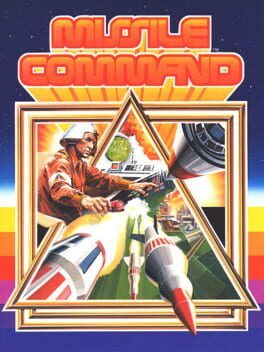
Missile Command
As a regional commander of three anti-missile batteries, the player must defend six cities in their zone from being destroyed. The player's six cities are being attacked by an endless hail of ballistic missiles, some of them even splitting like multiple independently targetable reentry vehicles (MIRVs). New weapons are introduced in later levels: smart bombs that can evade a less than perfectly targeted missile, and bomber planes and satellites that fly across the screen and launch missiles of their own.
| Released | 1980 |
|---|---|
| Developer | Atari |
| Publisher | Sega |
Platforms & ports
Screenshots
8images — scroll sideways, click to enlarge
Video
History
Missile Command is a 1980 shoot 'em up video game developed and published by Atari, Inc. for arcades. It was released by Taito and Sega in Japan. The game was designed by Dave Theurer, who would also design Tempest for Atari the following year. The player uses a trackball to defend six cities from intercontinental ballistic missiles by launching anti-ballistic missiles from three bases.
Missile Command was released in June 1980 during the Cold War, where it achieved widespread critical and commercial success. Atari then ported it to home systems beginning with an Atari 2600 conversion in 1981 by Rob Fulop. Numerous clones and modern remakes soon followed, and the version ported to Atari's 8-bit computers was reused for the 5200 in 1982 and built into the XEGS in 1987. It is considered to be one of the greatest video games of all time.
Gameplay
In Missile Command, six cities are being attacked by an endless hail of ballistic missiles, some of which split like multiple independently targetable reentry vehicles. New weapons are introduced in later levels: smart bombs that can evade a less-than-perfectly targeted missile, and bomber planes and satellites that fly across the screen launching missiles of their own. The player takes control three missile batteries in an effort to defend the cities for as long as possible.
The game is played by moving a crosshair across the sky background via a trackball and pressing one of three buttons to launch a counter-missile from the appropriate battery. Counter-missiles explode upon reaching the crosshair, leaving a fireball that persists for several seconds and destroys any enemy missiles or craft that enter it. The three batteries provided are each armed with ten missiles; a battery becomes useless when all of its missiles have been launched or if it is destroyed by enemy fire. whichever occurs first. The missiles of the center battery fly to their targets at much greater speed than those fired from the other two; only these missiles can effectively destroy a smart bomb at a distance.
The game is staged as a series of levels of increasing difficulty. Each level contains a set number of enemy weapons, which attack both the cities and the missile batteries and can destroy any target with one hit. Enemy weapons are only able to destroy three cities during one level. A level ends when all enemy weapons have been destroyed or have reached their target. A player who runs out of missiles no longer has control over the remainder of the level. At the conclusion of a level, the player receives bonus points for all remaining missiles and cities; at preset score intervals, the player earns a bonus city that can be used to replace a destroyed one at the end of the current level. These bonus cities can be kept in reserve and are automatically deployed as needed. The scoring multiplier begins at 1x and advances by 1x after every second level, to a maximum of 6x; this multiplier affects both target and bonus values.
The game inevitably ends once all six cities are destroyed and the player neither has any in reserve nor earns one during the current level. Like most early arcade games, there is no way to "win"; the enemy weapons become faster and more prolific with each new level. The game, then, is just a contest in seeing how long the player can survive. On conclusion of the game, the screen displays "The End", rather than "Game Over", signifying that "in the end, all is lost. There is no winner". This conclusion is skipped, however, if the player makes the high score list and the game prompts the player to enter their initials.
Development
Having found a picture of a radar screen in a magazine, Gene Lipkin, then president of Atari's coin-op division, tasked department head Steve Calfee to "Make me a game like this". At this time, games were usually developed by a single programmer with a deadline of six months. If the project was high-profile, this programmer could be assigned a junior programmer as an extra resource. Dave Theurer, who was free after finishing Atari Soccer as a junior programmer, was offered the project, loosely defined as "radar screen showing missiles fired from the USSR toward the US, which is defended by the player". Because the project was requested by a boss, it was considered "high profile" and a junior programmer, Rich Adam, was assigned to Theurer.
Calfee, Theurer and Adam then worked on refining the game concept. In early iterations, the cities represented six cities in California: Eureka, San Francisco, San Luis Obispo, Santa Barbara, Los Angeles, and San Diego. While Theurer understood the assignment of making a patriotic game, the current political climate made Theurer hesitant about the possible violent incitations. While enthusiastic about his first project, Theurer put two conditions to his work: neither the attacking nor defending states would be named, and the game would be purely defensive and never put players in situations where they would be the aggressor. As a result, the city names were removed completely. Players would also not be able to retaliate, as that would be a scenario of mutual assured destruction, which Theurer didn't find noble: "I did not want to put the player in a position of being a genocidal maniac. Only a crazy person would sling nuclear weapons without context, right?". Removing mentions of countries and cities would also leave the story's details to the player's imagination. The only possible game outcome of total destruction was also a message on the futility of war.
To make the game fast-paced, Theurer opted for a trackball as a control, faster than a joystick. The game would also be the first color game made by Atari. Both features ensured the game would stand out compared to the competition of the time. The cabinet would also be innovative, featuring an extra panel of light indicators tied to events in the game.
As the deadline was approaching, the programmers started crunching heavily and Theurer suffered from nightmares of being destroyed by a nuclear blast. A common observation at Atari at the time was that no programmer ever succeeded at having their first game released. This common occurrence was seen as a part of a programmer's learning curve but was putting extra pressure on Theurer (this rule was later named "Theurer's law" for being a famous exception).
Coin-op games had to go through early "field tests" where Atari would pay an arcade owner to place their prototype in the arcade for a few days so that the developers could observe player behaviour and reaction, find bugs and ensure the players were understanding the game and having fun. The game was an instant hit but the extra indicator panel was distracting the player and taking their attention from the screen, thus was scrapped entirely.
Reception
Missile Command is considered one of the classic video games from the golden age of arcade games. It is also noted for its manifestation of the Cold War's effects on popular culture, in that it features an implementation of National Missile Defense and parallels real-life nuclear war.
The game was an instant hit, hailed for its uniqueness, color graphics and challenging, score-based gameplay, which were massive draws for arcade games at the time. The game sold nearly 20,000 arcade cabinets. Missile Command was a commercial success for Sega in Japan, where it was among the top ten highest-grossing arcade games of 1980.
In 1983, Softline readers named the Atari 8-bit version of Missile Command eighth on the magazine's top thirty list of Atari programs by popularity. In a retrospective review, Brett Weiss of Allgame gave the arcade version a perfect score of 5 out of 5, in terms of controls, frenetic gameplay, sound effects, theme, and strategic aiming and firing.
In 1995, Flux magazine ranked the arcade version 24th on their "Top 100 Video Games".
== Ports ==…
Adapted from Wikipedia , licensed under CC BY-SA 4.0. Text may have been shortened.