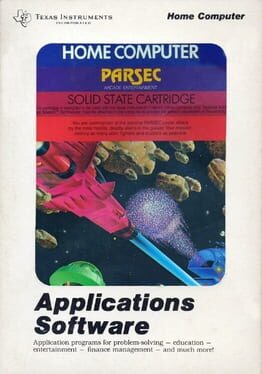
Parsec
Parsec is a computer game for the Texas Instruments TI-99/4A. Perhaps the best-remembered of all TI-99/4A games, it is a side-scrolling shooter, programmed in 1982 by Jim Dramis (who also programmed the popular TI-99/4A games Car Wars and Munch Man) and Paul Urbanus. The player in Parsec pilots a spaceship through sixteen differently-colored levels of play which scroll horizontally over the screen. The objective is to avoid being shot by an enemy ship, colliding with any flying object and/or the ground, and destroy all enemy ships without overheating one's laser cannon. Three waves of fighters attack, alternating with three waves of cruisers. Enemy ships enter the screen one at a time. A ship flying off the left edge of the screen wraps around to the right side and attacks again. A new fighter can appear with others still on the screen, whereas a new cruiser will not come until the previous one is destroyed. The fighters pose only the threat of collision, while the cruisers fire on the player's ship. The fighter types are named Swoopers, LTFs (Light Triangular Fighters), and Saucers. The cruisers are called Urbites, Dramites, and Bynites. Each level ends with an asteroid belt, in which an array of asteroids advance on the ship and must be avoided or shot. At the end of each asteroid belt, any remaining asteroids are cleared away and the color of the ground is changed, then a new wave of Swoopers begins. Starting with level 4, the Swoopers are preceded by a random number of Killer Satellites, which come without the usual computer warning. The Urbites and Dramites appear to be named after the developers of the game, while the Bynites were apparently named after Don Bynum (the manager of TI's Personal Computer Division) or possibly named after the fact that they have invisibility (by night). In fact, Paul Urbanus signed Internet posts as late as 2005 as "urbite".
| Released | 1982 |
|---|---|
| Developer | Texas Instruments Incorporated |
| Publisher | Texas Instruments Incorporated |
| Orientation | Horizontal |
Screenshots
1image — scroll sideways, click to enlarge
Video
History
Parsec is a horizontally scrolling shooter written by Jim Dramis and Paul Urbanus for the TI-99/4A and published by Texas Instruments in 1982. Dramis also programmed Car Wars and Munch Man for the TI-99/4A.
Gameplay
The player in Parsec pilots a spaceship through sixteen differently colored levels which scroll horizontally across the screen. The objective is to destroy all enemy ships while avoiding being shot, colliding with any flying object or the ground, or overheating one's laser cannon.
Three waves of fighters alternate with three waves of cruisers; fighters pose only the threat of collision, while the cruisers fire on the player's ship. Enemy ships enter the screen one at a time. A new fighter can appear with others still on the screen, whereas a new cruiser will not come until the previous one is destroyed. A ship flying off the left edge of the screen wraps around to the right side and attacks again. The fighter types are named Swoopers, LTFs (Light Triangular Fighters), and Saucers. The cruisers are called Urbites, Dramites, and Bynites. Each level ends with an asteroid belt, in which an array of asteroids advance on the ship and must be avoided or shot. At the end of each asteroid belt, any remaining asteroids are cleared away and the color of the ground is changed; then a new wave of Swoopers begins. Starting with level 4, the Swoopers are preceded by a random number of Killer Satellites, which come without the usual computer warning.
The Urbites and Dramites appear to be named after the developers of the game; Paul Urbanus signed Internet posts as late as 2005 as "urbite". The Bynites were likely named after Don Bynum, the manager of TI's Personal Computer Division.
Speech
The optional speech synthesis adds drama to the gameplay. Although it warns of advancing enemy craft and low fuel, both of these also have visual cues. The sole exception is in the asteroid belts between levels, whose length increases with the level number. There is a spoken countdown for each asteroid belt. Without the speech synthesizer there is no indication of how long the asteroid belt will last.
The voice of the on-board computer was performed by Aubree Anderson, who at the time was a student at Texas Tech University.
Legacy
The speech data for Parsec, Alpiner and Moon Mine was later acquired by Plogue Art et Technologie, Inc. The data for all three games was used for the software Chipspeech to create the voice of character "Lady Parsec".
Adapted from Wikipedia , licensed under CC BY-SA 4.0. Text may have been shortened.