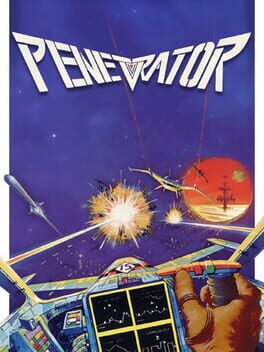
Penetrator
Penetrator is an early Sinclair ZX Spectrum game made by Melbourne House programmers Philip Mitchell and Veronika Megler, one of the early hits. It was released in 1982 as a clone of the Scramble arcade game. In Penetrator, the gamer flies a ship, which can shoot forwards and drop bombs beneath the ship. The first level is on open air, with just mountains to dodge, missiles which try to hit the ship, and animated radars. From the second level onwards, the game is inside increasingly complex caverns, so the ceiling is also a danger, as well as new enemies - the missiles are now sometimes replaced with skulls that can move up and down, blocking the path. The levels change with no pause, only the screen colour changes. After four levels there is a short fifth level where a base needs to be destroyed by dropping a bomb precisely, and then there is a firework animation as a reward. After all levels are finished, the ship goes back through inversed levels, with backward turned landscape. Reviews at the time said that graphics and the game were impressive, even stunning.[1] There is an edit mode for designing levels, and a training mode with infinite number of lives in which one can start from any level. Also, there is a simultaneous two-player mode. The game's sound consisted of a characteristic uplifting theme before ship launch, while in-game there were simultaneous shooting/explosion effects, which was relatively advanced use of the limited one channel Spectrum beeper system at the time. Later, versions for Commodore 64 and TRS-80 appeared.
| Released | 1982 |
|---|---|
| Developer | Beam Software |
| Publisher | Melbourne House |
Where to buy
Prices are cached and may be out of date — check the storefront before buying.
Platforms & ports
Screenshots
5images — scroll sideways, click to enlarge
Video
History
Penetrator is a 1982 horizontally scrolling shooter developed and published by Melbourne House for the ZX Spectrum. Programmed by Philip Mitchell and Veronika Megler, the game is a clone of Konami's 1981 arcade game Scramble. Penetrator was ported to the TRS-80 and Commodore 64.
Gameplay
In Penetrator, the player flies a ship which can shoot forward and drop bombs. Levels scroll from right to left, with a line representing the ground. The first level is in open air, with just mountains to dodge, missiles which try to hit the ship, and animated radars. From the second level onward, the game is inside increasingly complex caverns, so the ceiling is also a danger, as well as new enemies. The missiles are now sometimes replaced with skulls that can move up and down, blocking the path.
The levels flow seamlessly into each other, signified by screen colour changes. After four levels there is a short fifth level where a base needs to be destroyed by dropping a bomb precisely, and then there is a firework animation as a reward. After all levels are finished, the ship goes back through reversed levels. The ultimate level results in a seemingly impassible landscape, however due to a bug if the player accelerates into it, they can get through but the game crashes shortly after.
In addition to the single-player game, there's an alternating two player mode, and a training mode with unlimited lives and access to any of the levels, plus a level editor.
Reception
The Computer Gamer review of the Commodore 64 version in highlighted the versatility of the level editor.
BYTE praised the graphics of the TRS-80 version of Penetrator and described the game as "eminently playable".
In a summary of game genres, Computer and Video Games chose Penetrator as an exemplary Spectrum Scramble-type game, noting the responsive controls and their "thoughtful" layout on the keyboard. One criticism was the slow pace of the title screen: the player is presented with a fireworks display and slowly-drawn title before play can proceed.
Adapted from Wikipedia , licensed under CC BY-SA 4.0. Text may have been shortened.