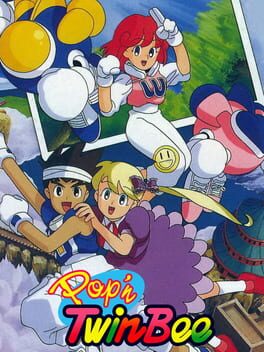
Pop'n TwinBee
A sequel to the original TwinBee released for the Game Boy portable consoles. Pop'n TwinBee puts you behind the controls of two experimental TwinBee fighters as you attempt to rescue Dr. Cinnamon from evil alien forces. In order to do that you must journey through 6 different planets filled with cute and surreal creatures bent on your destruction. The game uses the classic gameplay mechanics for the genre, with you controlling your craft as the background scrolls vertically towards the end of the stage and trying to survive and destroy all enemies with your laser shots. Twinbee features a selectable power-up system in which you must shoot the bell power-ups to select which type of upgrade you want depending on the color they take (or in this case, the shade of grey). Despite the European title, the Japanese version actually predates the release of the Super Famicom version of Pop'n TwinBee by three years.
| Released | 1990 |
|---|---|
| Developer | Konami |
| Publisher | Konami |
Platforms & ports
| System | Year | Region | Notes |
|---|---|---|---|
| 3DS Nintendo 3DS | 2012 | — | — |
Screenshots
4images — scroll sideways, click to enlarge
Story
The TwinBees, who were living peacefully in Donburi Island, receive a challenge from an unknown individual calling himself Dr. Nikki. "How dare you destroy my creation King Spice, as well as Gattlantis and Poko Poko! This time I'll be your opponent. I'll be waiting for you at Puka Puka Island."
Dr. Nikki was none other than Dr. Cinnamon's childhood rival. Whereas Cinnamon decided to use his intellect for the greater good, Nikki became a mad scientist. After reading the challenge, TwinBee and WinBee decide to head to Puka Puka Island without Dr. Cinnamon's knowledge, leaving GwinBee in charge of protecting the scientist. Can the TwinBees truly defeat Dr. Nikki?
History
TwinBee (ツインビー) is a video game series composed primarily of cartoon-themed vertically scrolling shooter games produced by Konami that were released primarily in Japan. The series originated as an arcade video game simply titled TwinBee in 1985, followed by several home versions and sequels. The character designs of almost every game in the series since Detana!! TwinBee in 1991 were provided by Japanese animator Shuzilow HA (Jujiro Hamakawa), who also planned and supervised most of the subsequent installments in the TwinBee series. The series also inspired a radio drama adaptation that lasted three seasons in Japan, as well as an anime adaptation.
History
The series centers around a blue bee-shaped anthropomorphic spacecraft named TwinBee, who is usually accompanied by a pink "female" counterpart known as WinBee. In most games, the first player controls TwinBee while WinBee is controlled by the second player. A third ship also exists named GwinBee, a green counterpart to TwinBee and WinBee who in most games serves as a power-up, but in some instances also appear as a third playable spacecraft. In contrast to the serious sci-fi theme of Konami's Gradius series, the TwinBee series is set in a cartoon-like world featuring several kinds of anthropomorphic creatures in addition to regular human characters. The player controls their spacecraft in most games shooting or punching at airborne enemies while throwing bombs at enemies on the ground, similarly to Namco's Xevious. The main power-ups in the TwinBee are yellow bells that the player can uncover by shooting at the floating clouds. The player must shoot these bells to keep them afloat and after shooting them a number of times, they will change colour, allowing the player to add new abilities to their spacecraft.
Despite being one of Konami's most prominent series in Japan during most of the 1990s, only a select few titles were localized for the foreign market, particularly the second console game Moero! TwinBee (which was released in America under the changed title Stinger); the two SNES installments, Pop'n TwinBee and Pop'n TwinBee: Rainbow Bell Adventures, in Europe and TwinBee Da!! for Game Boy, which was released in Europe as a standalone title with the name Pop'n TwinBee and later in compilations. The second arcade game, Detana!! TwinBee, also had a limited international release under the name of Bells & Whistles. The original arcade game was featured in the Nintendo DS compilation Konami Classics Series: Arcade Hits under the name RainbowBell (the European compilation, however, uses the original TwinBee name).
On June 6, 2025, Konami Amusement held the TwinBee Lottery, a lottery sale to commemorate the series' 40th anniversary. The lottery sale offered a chance to win TwinBee items featuring numerous original illustrations, as well as special E-amusement pass cards as bonus gifts.
List of games
TwinBee, released on March 5, 1985: An original arcade vertical shooter, TwinBee plays similar to Namco's Xevious. Players use TwinBee or WinBee in a short string of six levels that repeats indefinitely, with a boss at the end of each. A Family Computer (Famicom) and an MSX version were made in 1986. The Famicom version was re-released for the Game Boy Advance under Nintendo's Famicom Mini label in Japan only. It was released in North America as part of an arcade compilation for Nintendo DS in March 2007, where it was renamed RainbowBell; when the compilation was released in Europe, the TwinBee name was restored.
TwinBee Deluxe, released on February 25, 2004: The mobile version just like a WinBee in a Deluxe game.
Mini Famicom: TwinBee, released on May 21, 2004: The Famicom version was re-released for Game Boy Advance as part of the Mini Famicom line.
3D Classics: TwinBee, released on August 10, 2011: The game was also redone in 3D and released on the Nintendo eShop under Nintendo's 3D Classics line.
Stinger, released on November 21, 1986 and in 1987 in America, is the first game in the TwinBee series that was released in North America. Some enemy force kidnaps Dr. Cinnamon (creator of the TwinBee ships) and TwinBee, WinBee and GwinBee must rescue him. The Japanese version for the Family Computer Disk System in 1986, this game allowed up to three players simultaneously. Unlike its predecessor, Stinger has horizontal shooter levels (like Gradius) in addition to the vertical ones. Since the Disk System extension was not released in North America, the American version was released as a cartridge, but it lost the three-player mode (only allowing for up to two players), the story scenes were removed and the difficulty was altered. Moero! TwinBee was re-released in cartridge format in 1993 with a new easy mode added.
TwinBee 3: Poko Poko Daimaō, released on September 29, 1989, is the last game in the TwinBee series for the Famicom to be released and the third game in the series. It ditches Stinger's horizontal levels, which makes this more in line with the first title.
Pop'n TwinBee, first released on October 12, 1990, in Japan and in autumn 1994 in Europe, the game is a sequel for the Game Boy to the original TwinBee. In Japan, it is known as TwinBee Da!!. Despite the European title, the Japanese version actually predates the release of the Super Famicom version of Pop'n TwinBee by three years. The game was re-released as part of Konami GB Collection Vol.2 in Japan, while a colorized version was released as part of Konami GB Collection Vol.3 in Europe. A full remake is featured in TwinBee Portable for PlayStation Portable.
Detana!! TwinBee (also known as Bells & Whistles outside Japan), first released on February 21, 1991: An arcade release, also ported to the PC Engine (which was ported to Virtual Console), X68000, PlayStation and Saturn (the latter two bundled with TwinBee Yahho!). It has no relation to the original and Famicom games. While not too different from its predecessors, gameplay-wise, Detana! improves vastly on graphics and audio. It also introduces the current character cast, like TwinBee's and WinBee's characters (Light and Pastel, respectively) and other characters that would remain in the subsequent games. It was the most popular game in the series in Japan and paved the way for some merchandise products (including audio dramas and an original video animation). This also introduced cutscenes that played between stages, which usually showed Pastel and WinBee getting one up on Light and TwinBee.
Pop'n TwinBee, first released on March 26, 1993, and later in 1993 in Europe: A SNES game, it is one of Detana!'s sequels, though they play differently. Pop uses a large energy bar, which results in game over if it depletes. When playing with two players, it is also possible to share energy.
Pop'n TwinBee: Rainbow Bell Adventures (TwinBee: Rainbow Bell Adventure in Japan), released on January 7, 1994, in Japan and also in Europe during the same year. This SNES game meant the first real departure in the series. Rainbow Bell Adventures is a side-scrolling platformer. The game was also released in Europe, though the level order, some dialogue and the back-up system (the European version uses passwords, while the Japanese one uses battery) are different.
TwinBee Taisen Puzzle-Dama published on December 9, 1994, in Japan. It is a puzzle video game for PlayStation; simple mechanics are part of a series of puzzle games Taisen Puzzle-Dama and takes its theme the world of TwinBee. The game was also planned to be released on the Saturn in 1995 before it was cancelled.
TwinBee Yahho!, released on April 19, 1995:, is another sequel for Detana!, originally released in arcades, and later ported to the PlayStation and Saturn (along with Detana! TwinBee). The game included a vocal theme song, among other vocals, with WinBee greeting the arcade owner each time it is booted, and various snatches of dialogue from most of the characters, all voiced by the cast of TwinBee Paradise.
Detana TwinBee Yahho! Deluxe Pack, a compilation released on September 29, 1995, in Japan for the PlayStation and subsequently ported to the Saturn, it contains Detana!! TwinBee and TwinBee Yahho!.
TwinBee Paradise in Donburishima (ツインビーPARADISE in どんぶり島, Tsuinbī Paradaisu in Donburishima), released on February 26, 1998: More than a game, this is a CD-ROM with accessories inspired by the series (as a screensaver, etc.) for Windows 95.
TwinBee RPG, released on April 3, 1998: Featuring 3D graphics and made for the PlayStation, this simplistic role playing game, set in the complete universe of the series, was the last stand-alone retail release in the series.
Pastel Jan (パステルじゃん), released on 2002: A rock-paper-scissors video game for mobile phones.
Konami Suzume 〜 TwinBee Taisen-ban 〜 (コナミ雀〜ツインビー対戦版〜), released on May 6, 2003: A mobile title that is part of Konami Taisen Colosseum (コナミ雀〜ツインビー対戦版〜)
TwinBee Dungeon, released on May 14, 2004, is a roguelike dungeon RPG for cell phones themed on TwinBee universe which…
Adapted from Wikipedia , licensed under CC BY-SA 4.0. Text may have been shortened.