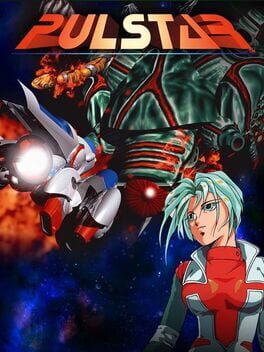
Pulstar
The basic gameplay is simple: progress through the levels in the spacecraft, collecting powerups and protecting the spacecraft from destruction. The game has very obvious similarities in design and gameplay to R-Type. It is actually believed that some ex-Irem employees left the company to join Aicom, which used to be a subcontractor for various coin-op manufacturers like Jaleco or SNK. Despite the familiarities, Pulstar is not without innovations. There is the option of using the weapon power bar, which consists of two halves. The right-hand side of the bar turns blue when the fire button is depressed. When fully charged the ship delivers a devastating emission of energy. The left-hand side turns red when it is continually pressed, shooting out a barrage of smaller, rapid blasts. The in-game visuals are mostly pre-rendered 3D graphics, which gives the interactive elements a far more realistic appearance. Great care was taken to really place the player into the world of the game, with cinematic style cut scenes and pre-rendered movies. There is a hefty reliance on strategy and not just blasting everything in sight. Using the charged weapon is key, and requires careful precision. Also, once a power up is obtained, a small orb appears at the posterior end of the ship. This can be used as an advantage by deflecting/absorbing oncoming enemy fire and taking out small enemies that run into it.
| Released | 1995 |
|---|---|
| Developer | Aicom |
| Publisher | SNK |
Where to buy
Prices are cached and may be out of date — check the storefront before buying.
Platforms & ports
Screenshots
12images — scroll sideways, click to enlarge
Video
Story
In the year 2248, the first recorded sign of extraterrestrial life was discovered coming from Mars. The signal emanated from the planet and from it an object travelled through space at light speed out of the Solar System. Earth scientists read the signal, but not knowing the nature of it, warned the world's defenses in case aliens traced the signal and followed it to Earth with the intent to destroy.
Eight years later, aliens followed the signal to the Solar System and began attacking the human space craft awaiting them along Neptune’s orbit. The battle between the humans and aliens spread throughout the Solar System; within two years of combat Neptune was disintegrated, Jupiter was turned into a star and more than half of Earth's continents sank from rising ocean levels and the planet's changing axis as a result. Kaoru Yamazaki, lone fighter pilot of the Dino246, is one of the few survivors left of the Pulstar attack force founded to save the Solar System from the alien invaders; it is through her that mankind may have a chance to survive the alien menace.
History
Pulstar is a horizontally scrolling shooter released for arcades by SNK in 1995. Players control a starship in its mission to eradicate the Solar System of a hostile race of aliens that threaten mankind. Its gameplay has been compared to the R-Type series for its similar premise and mechanics; players must complete each of the game's eight stages by destroying constantly-moving formations of enemies and avoiding their projectiles. There are power-ups that can be collected that provide additional abilities for the player. It runs on the Neo Geo MVS arcade system board.
Developed by Aicom, Pulstar is the first Neo Geo game to incorporate 3D pre-rendered visuals. Its music was composed by Harumi Fujita and Yasuaki Fujita, both of whom previously worked for Capcom on the Ghosts'n Goblins series. Pulstar has been ported and re-released several times, seeing conversions for systems like the Neo Geo CD and digital storefronts such as the Wii Virtual Console. The game and its re-releases have received mixed reviews from critics, who felt its gameplay and graphics were good but its difficulty was too high and it lacked originality. A sequel named Blazing Star was released in 1998, which aimed to correct the flaws present in the original.
Gameplay
Pulstar is a horizontally scrolling shooter in the same vein as the R-Type series. The player controls a starship, the Dino246, in its mission to protect the entirety of the Solar System from a hostile race of aliens. There are eight stages total, which become progressively more difficult as the player progresses. They scroll automatically, and the player is given a free range of movement. In these levels, the player must destroy constantly-moving waves of enemies and avoiding their projectiles, as well as dodging moving obstacles. Levels conclude with a boss that must be defeated.
The player's main form of attack is a forward-moving projectile. The player can hold down the button to charge their attack, with its power indicated by a meter at the bottom of the screen; the blue half creates a powerful charge shot, while the red half creates a barrage of rapid blasts. Players can also acquire an auxiliary drone that acts as a shield by protecting them from enemy fire. It can also be used as a battering ram to destroy smaller enemies. The drone can also be destroyed to create a powerful bomb attack that can destroy anything in its radius. Destroying large carrier-like enemies drops a power-up item that grants different abilities. These include capsules that increase the player's speed and smaller ships that follow the player and provide additional firepower.
Development and release
Pulstar was released for arcades on 28 August 1995. It was developed by Aicom and published by SNK. Produced for the Neo Geo AES arcade system, Pulstar was known under the codename of Project Dino during development, and was designed to be technologically impressive for the time period. It is the first Neo Geo game to incorporate pre-rendered graphics, which are 3D models converted into 2D images to create the illusion of a 3D environment. The soundtrack was composed by Harumi Fujita and Yasuaki Fujita, both of whom were previously employed at Capcom and worked on their Ghosts'n Goblins series. Harumi Fujita composed the music for Pulstar under the mindset of its freedom from sound chip limitations, allowing her to create music that corresponded to the game's environment and match her vision.
A version of Pulstar was released for the Neo Geo AES system in September, followed by a home release for the Neo Geo CD in October. In France, the AES version was distributed by Guillemot International. The Neo Geo CD version adds a higher-quality soundtrack and cutscenes between stages. In 2012, Pulstar was digitally re-released for the Japanese Wii Virtual Console service, courtesy of D4 Enterprise. Pulstar is included in the Neo Geo 25th Anniversary Humble Bundle, released in 2015. Hamster Corporation re-released Pulstar for the Xbox One, PlayStation 4, and Nintendo Switch in 2017 under their Arcade Archives series.
Reception
In Japan, Game Machine listed Pulstar on their 1 October 1995 issue as being the seventh most-popular arcade game at the time. Harumi Fujita claims that the game was received positively by SNK and Neo Geo fans.
Pulstar drew a wide range of opinions from critics, many of which drew comparison with the R-Type series. Maximum gave the Neo Geo AES version a rave review, particularly applauding the impressive-looking bosses and the extremely high and intelligently designed challenge. They also regarded the game as a sign that SNK was branching out from one-on-one fighting games. Major Mike gave it a more mixed review in GamePro, describing it as an imperfect and unoriginal shooter which manages to distinguish itself through its high difficulty and rendered graphics. He criticized that objects often blend into the backgrounds, but like Maximum, he particularly noted the visually impressive bosses. A reviewer for Next Generation panned the game, contending that the gameplay mechanics fail to surpass even shooters of the early 1980s. He concluded, "If it weren't for the molasses like pace of the game, then Pulstar could've been another generic shooter. Instead, it's even worse".
In 2014, HobbyConsolas identified Pulstar as one of the twenty best games for the Neo Geo CD. Likewise, Time Extension also listed it as one of the best games for the Neo Geo.
Legacy
A sequel named Blazing Star was released by SNK in 1998. Blazing Star features multiple additions to the core gameplay of its predecessor, such as a wide selection of playable ships and new power-up types. It was developed by Aicom, who had changed their name to Yumekobo during production. The development team noticed the stigma against Pulstar in arcades for its high difficulty, and wanted Blazing Star to have its own identity and improve on the original's flaws. Upon release, Blazing Star received far better reviews for its graphics, gameplay, and difficulty balance, and was described as being part of SNK's efforts in keeping older game genres alive.
Adapted from Wikipedia , licensed under CC BY-SA 4.0. Text may have been shortened.