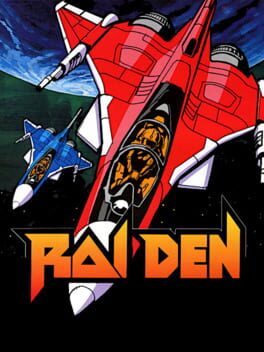
Raiden
Raiden consists of eight vertical scrolling missions where the player maneuvers the Raiden craft dodging and destroying enemy robots, buildings, ground targets, and aircraft. There are bombs and missile powerups as well as collectable medals which add to the score. When player dies, the fighter's fragments become projectiles that damage enemies. After defeating the Stage 8 boss, the mission is completed, and player receives 1 million points for each completed loop. Afterwards, it will start back to Stage 1. This time around, enemies shoot faster and at a more rapid rate.
| Released | 1990 |
|---|---|
| Developer | Seibu Kaihatsu |
| Publisher | Hudson Soft |
Platforms & ports
Screenshots
5images — scroll sideways, click to enlarge
Video
Story
In the year 2090, Earth has suddenly become the target of deranged aliens known as the Cranassians. Following the invasion, the World Alliance Military builds a new cutting-edge weapon, the Raiden Supersonic Attack Fighter. Based on a captured alien craft, it is humanity's only hope for survival.
History
Raiden is a 1990 vertically scrolling shooter video game developed by Seibu Kaihatsu and published by Tecmo for arcades. The game's story takes place in the year 2090, when an alien species known as the Crystals invaded Earth. Players assume the roles of the Vanquish Crystal Defense pilot duo, taking control of two state of the art Fighting Thunders aircraft to defeat the Crystals and save the Earth.
The game was conceived after Dynamite Duke, Seibu Kaihatsu's prior title, failed to sell as well as expected. During development, the game was designed as a vertically scrolling shooter due to the popularity of the genre at the time. Cheaper arcade hardware had to be used due to financial constraints caused by Dynamite Duke's poor sales.
Although Seibu doubted Raiden's success, it managed to sell 17,000 arcade units worldwide, helping to recuperate the company's investments through word-of-mouth. The title became a critical success, with its most lauded features being the graphics, music, gameplay and co-operative play.
Due to the success of Raiden, several sequels and related games were made. Raiden was ported to home computers and various home video game consoles in the early to mid 1990s. The game was released as part of several compilations and through download services such as PlayStation Network. The ports received mixed to positive reception.
Gameplay
Raiden is a vertically scrolling shoot 'em up game consisting of eight stages of increasing difficulty. In each stage, the player maneuvers the Fighting Thunder craft, engaging various enemies and avoiding their attacks. In cooperative play, both players can generate special projectiles that damage enemies by shooting the other player craft. After completing the eighth and final stage, the player returns to the first stage with the difficulty increased.
Collectible items include bombs, which cancel out enemy fire and deal damage over a wide area; weapon power-ups; and score-increasing medals. There are two bonus collectible items: the Miclus (a boss in Seibu Kaihatsu's 1985 title Wiz) and a fairy that releases power-up items when the player dies. When the player dies, the fighter's shrapnel become projectiles that damage enemies. If all lives are lost during a gameplay session, the game is over unless players insert more credits into the arcade machine to continue playing. Upon continuing, the player will start at the last checkpoint reached.
Plot
The story of Raiden takes place in the year 2090, when a species of alien lifeforms known as the Crystals invaded Earth. The Crystals took control over most of Earth's military hardware to use in the invasion. In response, the world organization known as Vanquish Crystal Defense (VCD) develops the Fighting Thunder attack craft, a cutting-edge weapon based on Crystal technology. To survive against the invaders and fight back, VCD deploys Fighting Thunder as the only hope for humanity. The game's setting and storyline focus on the use of advanced alien technology and resistance against the Crystal invasion.
Development
According to graphic designer and current MOSS CEO Toshinobu Komazawa, the creation of Dynamite Duke gave Seibu Kaihatsu the opportunity to begin developing Raiden, as the former did not sell as well as Seibu had hoped. In order to recoup the costs of developing Dynamite Duke, the decision was made to develop a shoot 'em up instead of a sequel to it. Komazawa noted that the development of Raiden had a negative outlook, but an earnest beginning, since the shoot 'em up genre was "relatively inexpensive to produce" games for, as well as increasing in popularity at the time. Due to financial constraints, the company opted to use arcade hardware less powerful than those used in their previous titles. Seibu could only afford to develop a shoot 'em up with their development budget, with the project becoming a financial decision, as they had no other choice of game to make. Seibu took production notes from the overseas market, borrowing ideas from popular titles such as Capcom's 1942, Xevious from Namco, and Twin Cobra by Toaplan.
The production of Raiden was led by Seibu Kaihatsu president Hitoshi Hamada, while Tetsuya Kawaguchi served as its designer and programmer K. Kondo and S. Mori were the other programmers. Komazawa, H. Matsuo, T. Matsuzawa and T. Wada were responsible for creating the in-game artwork. Y. Segawa was responsible for creating the arcade hardware. Near the end of development, Komazawa praised the programmers at Seibu for being able to produce a high-quality game on less powerful hardware.
Music
The music for Raiden was composed by Akira Sato. A Raiden/Raiden II soundtrack was published by INH Co., Ltd. It includes soundtracks from Raiden (Arcade, PlayStation), Raiden Densetsu (FM Towns), Raiden II (Arcade, PlayStation) and Raiden DX (Arcade) as well as other extras.
Release and ports
Raiden was first released in the arcades in April 1990 by Tecmo in Japan. It was released in North America by Fabtek, Taiwan by Liang HWA Electronics, South Korea by IBL Corporation, and Hong Kong by Wah Yan Electronics. The game was ported to various platforms, with each port featuring several changes and additions. In 2022, the arcade version will be included as part of the Sega Astro City Mini V, a vertically oriented variant of the Sega Astro City mini console.
The PC Engine conversion was developed by A.I Company and first published by Hudson Soft in Japan on 22 November 1991, and released a few months later on the North American TurboGrafx-16 by NEC Technologies. It is a mostly faithful port of the arcade original.
The Atari Jaguar version was developed by Imagitec Design, then released in North America in November 1993. The North America, Europe and Japan releases were distributed by Atari Corporation and Mumin Corporation in 1994 respectively. It features various presentation and gameplay changes from the original arcade version.
The MS-DOS port was coded by Nigel 'Freddy' Conroy, Steve Cullen and Martin Randall, and spearheaded by Martin Hooley at Imagitec. It shares the same visual design as the Jaguar conversion with the addition of a full-screen display. Its differences from the Jaguar port include support only for FM sound. It was released only in North America in 1994.
A handheld version was developed by BlueSky Software and launched for the Atari Lynx across North America and Europe in 1997 by Telegames, long after the Lynx's commercial lifespan had ended. It was only available through direct order and a few select retailers.
Raiden Trad and Raiden Densetsu
The FM Towns release was titled Raiden Densetsu ("Legend of Raiden") in Japan, while both the Mega Drive/Genesis and Super Nintendo Entertainment System ports were given the name Raiden Trad across all regions ("Trad" being an abbreviation of tradition, an alternative meaning of densetsu). Each version of Trad was developed and distributed by different developers and publishers; Toei Animation published the SNES version despite not providing animation services. A European release of the Mega Drive version was planned for release by Ubi Soft as part of a multi-game licensing deal with Bignet, but was never officially released in the region.
Super Raiden
Super Raiden is a PC Engine Super CD-ROM² version of the TurboGrafx-16 HuCard port. Its main new feature is the use of Redbook CD Audio for an arranged soundtrack, along with additional stages exclusive to the CD version. It was developed by A.I Company and released on 2 April 1992, in Japan by Hudson Soft.
The Raiden Project
Both the original Raiden and Raiden II were included as part of The Raiden Project compilation. The included games are based directly on the original arcade releases and offers several options not found in other ports. The Project version of the first Raiden was re-released by Hamster Corporation as a stand-alone PlayStation title for their Arcade Hits series. It was later available as a digital download on the Japanese PlayStation Network store, playable on the PlayStation 3 and the PlayStation Portable.
Re-releases
Raiden was first adapted on mobile phones by Com2uS in 2004. The original game was later included as part of the 2012 compilation Raiden Legacy by DotEmu for mobile devices, PCs and other platforms. Raiden Legacy also includes the three games in the Raiden Fighters sub-series. On July 1, 2021, the arcade version of the game got ported for modern consoles as part of the Arcade Archives series.…
Adapted from Wikipedia , licensed under CC BY-SA 4.0. Text may have been shortened.