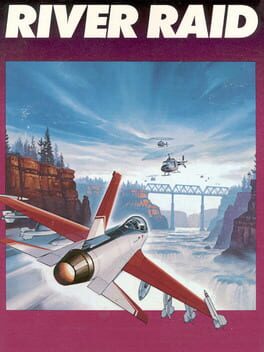
River Raid
Mission: Code Name River Raid. Jet down the river. Break the enemy blockade and blast the bridges to halt enemy troop advances. Terrain: Code Name River of No Return. An ever-changing, ever-challenging waterway. Expect huge islands, narrow channels and treacherous bays crawling with enemy choppers, tankers and jets. Weaponry: Code Name StratoStrafer. Your B1 StratoWing Assault Jet has been retrofitted with sophisticated, rapid-fire guided missiles. Your craft is super-sensitive to the stick. Accelerate, slow or bank radically with only a touch. Tactics: Jet low to the river to avoid radar. Stop periodically at depots to refuel. A warning claxxon will alert you. Top speed! Best of luck!
| Released | 1982 |
|---|---|
| Developer | Activision |
| Publisher | Pony Canyon |
Platforms & ports
Screenshots
5images — scroll sideways, click to enlarge
History
River Raid is a 1982 shoot 'em up video game developed and published by Activision for the Atari 2600 and designed by Carol Shaw. The player controls a fighter jet over the River of No Return in a raid behind enemy lines. The goal is to navigate the flight by destroying enemy tankers, helicopters, fuel depots and bridges without running out of fuel or crashing.
Before joining Activision, Shaw had developed games for Atari, Inc. Inspired by the arcade game Scramble (1981), she set out to make a game with a continuously scrolling screen. Shaw programmed and designed River Raid herself, taking occasional advice from other Activision staff.
River Raid was one of the best-selling games of 1983 and the second best-selling Atari 2600 video game of the year after Ms. Pac-Man. It received year-end awards from The Video Game Update and the Arkie Awards. The game was ported to several other consoles and computers and received a sequel in 1988. It has continued to receive praise as one of the best games for the Atari 2600 from various publications.
Gameplay
In River Raid, the player is in a B1 StratoWing Assault Jet that is retrofitted with rapid-fire guided missiles and has the ability to both accelerate and slow down easily. The jet is going down the "River of No Return" where it is on a mission to break the enemy blockades and halt troop advances. The river in the game has no ending and scrolls infinitely.
River Raid is played with the joystick. The player can move left and right on the screen and forward and backwards to accelerate and slow down respectively. The player can shoot missiles with the joystick's button to destroy enemy tankers, helicopters, fuel depots and bridges. The goal in River Raid is to collect as many points as possible before crashing or running out of fuel. Fuel can be collected by flying over a fuel depot to fill up the gauge that is displayed at the bottom of the screen. As the river progresses, there will be fewer fuel tanks. The player loses one of their jets if they collide with the river bank or enemy objects. If the player has remaining jets, they will respawn at the same section of the river they crashed. If a bridge is destroyed at the end of a section, the player will restart at that bridge upon losing a life.
In the Atari 2600 version, Switch A has missiles that shoot straight, while Switch B has guided missiles instead.
The port to Atari 8-bit computers adds the ability to select which bridge to start at, bonus points if the player shoots a bridge with tanks on it, and more hazards such as helicopters that fire back.
Development
River Raid was designed by Carol Shaw for Activision. Shaw had started programming in high school, coding in BASIC, which led her to pursue a career in computing. She received her bachelor's degree in electrical engineering and computer science at the University of California, Berkeley. While at university, she was in a work-study program that allowed her to work at various computer companies including a six-month position at Atari. She worked at Atari after graduation and developed 3-D Tic-Tac-Toe (1978) and Video Checkers (1980), which she described later on as not being "top-sellers". Shaw later accepted an offer to work on developing games for Activision.
Shaw programmed the game. She said the idea of the game was mostly her own, with some feedback from other designers. Shaw recalled that there were numerous video games with scrolling and thought it would be wise to develop the game for the Atari 2600. She was initially inspired by the game Scramble (1981) and approached Alan Miller of Activision to develop a space-themed game. Miller responded that there were too many outer space–themed games, suggesting her to come up with a different theme.
Shaw created a game where objects scroll down the screen. She began drawing the game on graph paper and found that creating a game which scrolled horizontally would not work well and would appear "very jerky", leading it to be designed to scroll vertically. While doodling on graph paper, she found that she could design the game with a mirror image looking like a river with islands in the middle of it. Initially, the players would be controlling a boat which Shaw felt did not look good. She recalled Activision programmer David Crane's suggestion that a jet would look better, and she began designing one which appeared to be flying up a canyon.
Some input came from either David Crane or Steve Cartwright to add fuel tanks that the player could fly over for fuel or shoot and destroy for points. Other gameplay elements followed after, such as how far apart bridges were. While developing the sound effects, she asked other Activision developers about appropriate Klaxon-styled sounds to warn the player when their fuel was running low. According to Crane, he thought for a moment and recited some lines of assembly code that created the effect.
Shaw coded the version for the Atari 800, which was eight kilobytes in size compared with the Atari 2600 version's four kilobytes. The home computer version, which she described as a "whole new game", required substantial new development. Most of the code for River Raid had to be re-written for the Atari computer version. Shaw said that she had "pretty much mastered playing the game" and thought it would be more fun to be able to start at a higher level. This led to her adding the ability to restart the game from a bridge further down the river. Shaw also designed more detailed graphics such as the canyon's river and walls.
Release
River Raid was published by Activision and released for the Atari 2600 on December 1982. It was released for the Atari 800 line of computers in September 1983 and both the Atari 5200 and Intellivision in December 1983. The game was also ported to other home computers such as the Commodore 64, ZX Spectrum, MSX and IBM PCjr.
In West Germany, the Law for the Protection of Youth was updated in 1985 to ban arcade games from public spaces open to young people. The Bundesprüfstelle für jugendgefährdende Schriften (Federal Department for Works Harmful to Young Persons, now the Federal Department for Media Harmful to Young Persons) consequently began monitoring video games, and River Raid was banned for its military-themed content.
River Raid has been re-released on several video game compilation packages. These include the Atari 2600 Action Pack (1995) for home computers, Activision Classics (1998) for PlayStation, Activision Anthology (2002) for PlayStation 2 and portable systems such as Game Boy Advance and PlayStation Portable.
== Reception ==…
Adapted from Wikipedia , licensed under CC BY-SA 4.0. Text may have been shortened.