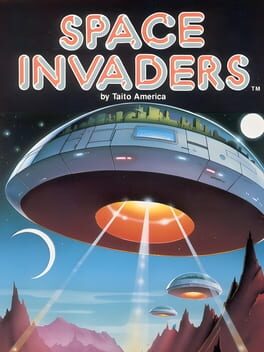
Space Invaders
Space Invaders is an arcade video game developed by Tomohiro Nishikado and released in 1978. It is one of the earliest shooting games and the aim is to defeat waves of aliens with a laser cannon to earn as many points as possible.
| Released | 1978 |
|---|---|
| Developer | Taito |
| Publisher | Midway Manufacturing |
Platforms & ports
Screenshots
5images — scroll sideways, click to enlarge
Video
History
Space Invaders is a 1978 shoot 'em up game developed and published by Taito for arcades. Taito released it in Japan in July 1978 and overseas through a partnership with Midway Manufacturing later that year. Space Invaders was the first video game with endless gameplay and the first fixed shooter, setting the template for the genre. The goal is to defeat waves of descending aliens with a horizontally moving laser cannon to earn as many points as possible.
Designer Tomohiro Nishikado drew inspiration from video games such as Gun Fight and Breakout, electro-mechanical target shooting games, and science fiction narratives such as the novel The War of the Worlds, the anime Space Battleship Yamato, and the film Star Wars. To complete development, he had to design custom hardware and development tools to use the features in microprocessor technology, which was new to him. Upon release, Space Invaders quickly became a commercial success worldwide; by 1982, it had grossed $3.8 billion ($10 billion in 2024-adjusted terms), with a net profit of $450 million ($1.2 billion in 2024 terms). This made it the best-selling video game and highest-grossing entertainment product at the time, and the highest-grossing video game yet. It is also one of the highest-grossing media franchises of all time.
Space Invaders is considered one of the most influential and greatest video games ever, having ushered in the golden age of arcade video games and Japan's long-lasting global success in the video games industry. It inspired several prolific game designers to join the industry and influenced numerous games across different genres. The game has been ported and re-released in various forms, including the 1980 Atari 2600 version, which quadrupled sales of the Atari 2600 console and became the first killer app for video game consoles. The pixelated enemy alien has become a pop culture icon, often representing video games as a whole. The game has spawned dozens of sequels and remakes, been the inspiration for numerous pieces of art and music, been parodied across media, and been the focus of several pieces of legislation to limit access to video games.
Gameplay
Space Invaders is a fixed shooter in which the player moves a laser cannon, referred to as a "Laser Base", horizontally across the bottom of the screen and fires at a group of the titular alien invaders overhead. The invaders begin as five rows of eleven—the amount differs in some versions—that move left and right as a group, advancing on the shooter by shifting downward each time they reach a screen edge. The goal is to eliminate all the invaders by shooting them. Regardless of how many game lives remaining the player has, the game ends if the aliens reach the bottom of the screen.
The aliens attempt to destroy the player's cannon by firing projectiles, which costs the player a game life if successful. The game ends after all lives are depleted. The laser cannon is partially protected by stationary defense bunkers that are gradually destroyed from above by the invaders; the bottom will be destroyed if the player fires when beneath one. As the invaders are defeated, their movement, as well as the accompanying music, speeds up. Defeating all the aliens brings another wave that starts lower, a loop that can continue endlessly. A special "mystery ship" will occasionally move across the top of the screen and award bonus points if destroyed.
Development
Space Invaders was developed by Japanese designer Tomohiro Nishikado, who spent a year designing it and developing the necessary hardware to produce it. Because he worked alone and handmade many of the development tools, the process incurred minimal costs. Taito originally did not credit a designer as anonymity was a required part of Nishikado's contract with the company.
The game was a response to Atari, Inc.'s 1976 arcade game Breakout. Nishikado noted that Breakout-style games were very popular in Japan in 1977. He was a fan of the game and aimed to create something better. The developer wanted to adapt the same sense of achievement and tension from destroying targets one at a time, combining it with elements of target shooting games. The game uses a similar layout to that of Breakout but with different game mechanics; rather than bounce a ball to attack static objects, players are given the ability to fire projectiles at moving enemies.
To improve the design, Nishikado felt the targets should have an interesting shape. Early enemy designs included tanks, combat planes, and battleships. Nishikado was not satisfied with the enemy movements; technical limitations made it difficult to animate flying. The designer believed animating human characters would have been easier to program, but he considered shooting them immoral. Nishikado also said that shooting people was frowned upon. After seeing the release of the 1974 anime Space Battleship Yamato in Japan, and seeing a magazine feature about the 1977 Star Wars, he thought of using a space theme. Nishikado drew inspiration for the aliens from the novel The War of the Worlds and created initial bitmap images after the octopus-like aliens. Other alien designs were modeled after squids and crabs. After creating the pixel art, Nishikado created a tool to animate two frames of movement for each character and adjusted the design on-screen with a light pen. He added the bunkers and the mystery ship to the playing field afterward.
Nishikado added several interactive elements that he found lacking in earlier video games, such as enemies reacting to the player's movement and returning fire, and a game over triggered by the enemies killing the player character rather than simply a timer running out. He replaced the timer, typical of arcade games at the time, with descending aliens who effectively served a similar function, where the closer they came, the less time remained for the player. During the process, Nishikado wanted the game's difficulty to increase the longer the game progressed; he reasoned this kept the gameplay fresh and that the game would earn less if players could play for extended periods. He relied on feedback from his coworkers to balance the difficulty; in retrospect, Nishikado stated that without their input he would have made the game less challenging because he struggled to play it. The game was originally titled Space Monsters after a popular song in Japan at the time, "Monster", but was changed to Space Invaders by the designer's superiors.
Hardware
Nishikado designed his own custom hardware and development tools for Space Invaders. The game uses an Intel 8080 central processing unit (CPU) and displays raster graphics on a CRT monitor using a bitmapped framebuffer. The game outputs monaural sound hosted by a combination of analog circuitry and a Texas Instruments SN76477 sound chip.
The adoption of a microprocessor was inspired by the 1975 arcade game Gun Fight, Midway's microprocessor adaptation of Nishikado's earlier discrete logic game Western Gun, after the designer was impressed by the improved graphics and smoother animation of Midway's version. At the time, Taito had licensed Midway's technology to use in its games. Nishikado used Midway's arcade board as a motherboard and created additional boards and circuitry to expand the capabilities.
As microprocessors were manufactured in the United States, Nishikado had to rely on his English skills, which he described as limited, to translate the reference material. He dedicated about six months to studying American games and mastering using a microcomputer. While planning the game, Nishikado made iterative improvements to the hardware. He attributes his previous experience working with integrated circuits and learning assembly language during his university studies with helping him learn how to interact with the new hardware.…
Adapted from Wikipedia , licensed under CC BY-SA 4.0. Text may have been shortened.