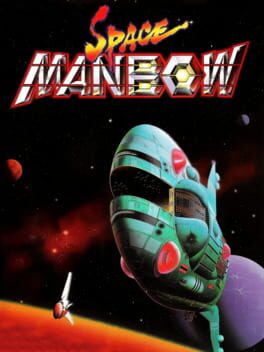
Space Manbow
In the year 189 of the stellar calendar, humanity happened upon the ruins of an ancient (and, if the st. 7 decor is anything to go by, rather decadent and malicious) civilization, and sent an archaeological crew to explore them. However, the crew managed to activate the ruins' defense system. The system operated by identifying the Sol system as the intruders' origin, then launched the Sun-Fish ("Manbou" being Japanese for "Sunfish"), an ultimate weapon bio-mechanical starship capable of destroying an entire solar system and protected by an impregnable force-field bubble. The surviving members of the crew, however, find a chance to stop the Sun-Fish. By using an unearthed Manbou-J (i.e. Junior Sun-Fish) fighter and activating a teleportation system in the deepest part of the ruins, one pilot, Cleaver Mule, can actually get inside the force bubble and destroy the Sun-Fish from there.
| Released | 1989 |
|---|---|
| Publisher | Konami |
Platforms & ports
Screenshots
6images — scroll sideways, click to enlarge
History
Space Manbow is a 1989 scrolling shooter video game developed and published by Konami for the MSX2 home computer. It was later ported to mobile phones, followed by digital re-releases for the Virtual Console and Microsoft Windows via Project EGG. The plot follows Kliever Mu, an archaeologist and former pilot, who takes on the mission of preventing the Manbow space battleship from destroying the solar system. The player controls the Manbow-J, fighting enemies and avoiding obstacles, while collecting power-ups to enhance the ship's firepower.
Konami's MSX division initially decided to adapt the arcade game Thunder Cross for the MSX, but the final product was deemed uninteresting. Konami would halt production if the game was not enjoyable, so the team remade it several times, but it still failed to get approval. Around that time, Osaka Gas began incorporating manbow fish into its advertising, and Akihiko Nagata, general manager of Konami's PC department, decided to capitalize on the idea. The game was redesigned from scratch, with input from other teams within the MSX division, resulting in Space Manbow. The soundtrack was composed by Tsuyoshi Sekito and Yuji Takenouchi using a sound chip that expanded the audio capabilities of the MSX.
Space Manbow earned critical acclaim, with praise for its audiovisual presentation, balanced difficulty, and smooth multidirectional scrolling. Retrospective commentary in the years following its release have hailed it as one of the best titles for the MSX.
Gameplay
Space Manbow is a scrolling shooter game. The premise takes place in the year 189 of the stellar calendar, where humanity has begun to expand into space. An archaeological research team discovers the ruins of an ancient civilization on a mechanized planet. As the research delves deeper into the subterranean depths, weapons installed across the planet begin to activate, as the ancient civilization's automated defense system was still active. Perceiving the team as an enemy and the research as an invasion, the planet's defense system deploys a colossal space battleship called the Manbow to attack the solar system. Archaeologist and former pilot Kliever Mu decides to use the Manbow-J, a fighter craft built from blueprints unearthed in the ruins, and take on the mission of preventing the Manbow from destroying the solar system.
The player controls the Manbow-J, fighting enemies and avoiding obstacles. The ship is equipped with a main front-firing weapon that can be switched between two types: a needle shot (N) and a wide shot (W). Weapons are obtained from items capsules dropped by defeated enemies. Firepower can be increased up to four levels by collecting red capsules, but the ship's power indicator will gradually decrease unless the player collects additional capsules. The ship can also be equipped with two option (O) units, which fly in a fixed top-down formation. These units only fire needle shots, but the player can freely adjust the firing direction forward, backward, or up and down. Enemies can also drop blue bomb capsules upon defeat, which the player can store and deploy to destroy all enemies. Other power-up items include a ground missile (M) and speed boosts (S).
There are a total of seven stages, each with a boss. Each stage scrolls in different directions: upwards, forwards, downwards, backwards, or diagonally. Being hit by an enemy, enemy fire, or colliding with obstacles results in the loss of a life. The player starts with three lives and can gain more by reaching certain score thresholds. The game is over once all lives are lost, although the player can start again or continue from the beginning of the last stage reached, but with the loss of collected items and a decrease in the power gauge.
Development
Space Manbow was developed by the MSX division at Konami's PC development department, under the general management of Akihiko Nagata. Initially, the team decided to adapt the arcade game Thunder Cross for the MSX. The final product was deemed excellent from a programming standpoint, but uninteresting and was not expected to sell well in its current state. Konami would order production to cease if the game was not entertaining, so the team repeatedly remade it under the working titles Alphard and Egzart, leading to constant delays, but it still failed to gain approval. Around that time, Osaka Gas began including the manbow, a popular fish back then, in its advertisements, and Nagata thought of taking advantage of the idea. Hideo Kojima and Konami composer Yasuhiko "Mansan" Manno recalled that one day, Nagata said aloud, "Manbow sounds good, right?" and everyone exclaimed, "Huh?". Deciding that the game would not work as it was, Nagata ordered the name changed, resulting in Space Manbow.
The MSX division consisted of four teams, each led by a different planner, who evaluated each other's games. If one team's game was deemed uninteresting, the others would halt their work and help rebuild it into a successful one. Since no member of the staff had prior experience in developing shoot 'em ups, Ryouhei "Ryokun" Shogaki, one of the developers responsible for The Maze of Galious (1987), and graphic designer Naoki Matsui stepped in to assist. Shogaki provided sketches for the player character and bosses, while Matsui advised on map layout and enemy obstacles. The team used this advice to redesign the game and replace all the sprites from scratch, a process that took a month, but culminated in Space Manbow being approved by Konami's top management. The game employs a sprite driver written by Konami, which doubles the maximum number of sprites the MSX2 can display to 64.
Tomiharu Kinoshita, who worked on MSX titles such as F-1 Spirit: The Way to Formula-1 (1987) and Snatcher (1988), created the ending sequence along with programmer Ritsushi Sagisaka. Kinoshita drew the storyboards and sprites, and provided the data to Sagisaka. He also offered his input on details such as screen timing, as he wanted the sequence to have the feel of a cinematic ending. Kinoshita did not have any music in mind, but after the ending theme was finished, he adjusted the timing and made modifications to the sequence until he managed to synchronize it and was satisfied. He recalled that the team felt unable to develop the game due to their inexperience with shoot 'em ups, as Gradius 2, Salamander, and Parodius were popular with fans and within Konami on the MSX. Kojima stated that Space Manbow turned out to be a good game thanks to the developers' dedication.…
Adapted from Wikipedia , licensed under CC BY-SA 4.0. Text may have been shortened.