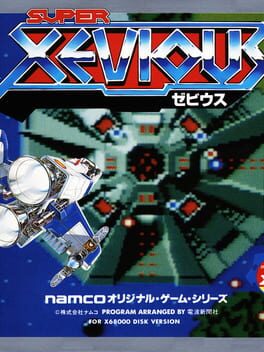
Super Xevious
The gameplay is very much like that of the original Xevious except this time it is a little more difficult. Several new enemies have also been introduced (including a silver Galaxian flagship, a rare silver Galaga "scorpion" ship, two jet planes, a helicopter, and a dark yellow Tank Battalion tank). Some of these enemies will reset the player's score back to 0 if they are destroyed - and the hidden "Sol Citadel" towers and Rally-X Special Flags are also located in different places.
| Released | 1984 |
|---|---|
| Developer | Namco Limited |
| Publisher | Micomsoft |
| Orientation | Vertical |
Platforms & ports
Screenshots
4images — scroll sideways, click to enlarge
History
Xevious is a 1983 vertically scrolling shooter video game developed and published by Namco for arcades. It was released in Japan and in North America by Atari, Inc. in February 1983. Controlling the Solvalou starship, the player attacks Xevious forces before they destroy all of mankind. The Solvalou has two weapons at its disposal: a zapper to destroy flying craft, and a blaster to bomb ground installations and enemies. It runs on the Namco Galaga arcade system. An upgraded version, Super Xevious, was released in December 1984.
The game was designed by Masanobu Endō and a small team. Created to rival the success of Scramble, it was originally themed around the Vietnam War and titled Cheyenne. Endō wanted the game to have a detailed, integral storyline and a comprehensive world, and to be welcoming for newer players. Several enemies and characters were made to pay homage to other popular science fiction works, including Star Wars, UFO, Alien and Battlestar Galactica.
Xevious was praised for its detailed graphics, challenge and originality. It became an unprecedented success for Namco in Japan, with record-breaking sales figures making it the biggest game since Space Invaders. The North American release paled in comparison, despite still selling 5,295 arcade units by the end of 1983. It has been listed among the most influential games in the shoot 'em up genre, establishing the template for vertically scrolling shooters and inspiring games such as TwinBee and RayForce. It was ported to home systems, followed by several sequels and spin-offs, and is included in many Namco compilations.
Gameplay
Xevious is a vertically scrolling shooter. The player controls a flying attack craft, the Solvalou, to destroy the Xevious forces plotting to take over Earth. The Solvalou has two weapons: a zapper that fires projectiles at flying enemies, and a blaster for bombing ground installations and vehicles. A reticle in front of the ship shows where bombs will land.
The game has a total of 16 connected areas, which loop back to the first after completing them all. Dying about 70% through starts the player at the beginning of the next. Areas are geographically distinct, with features such as forests, roads, rivers, and mechanical structures. Certain areas have Nazca lines placed on the ground, some in the "condor" design.
The game becomes progressively more difficult as the player becomes more skilled. Once the player does well at destroying a certain enemy type, a more advanced enemy type replaces it. Destroying flashing-red "Zolback" radars found on the ground will cause the game to switch back to easier enemies.
Certain points in the game have a fight against the Andor Genesis mothership, which launch an endless stream of projectiles and explosive black spheres known as "Zakatos". The player can either destroy all four blaster receptacles or the core in the center to defeat it. Some parts of the game have hidden towers ("Sol Citadels"), which can be found by bombing specific parts of an area. The Solvalou's bomb reticle flashes red when over one. Yellow "Special Flags" from Namco's own Rally-X are found in a semi-random section of the area. Collecting one gives an extra life.
Super Xevious includes multiple additions and changes to the original game. The gameplay overall is harder, with more aggressive enemies and faster-moving projectiles. New enemy types include fighter jets, tanks, helicopters, and silver-plated Galaxian flagships, which are found in specific areas of the game. Some of these enemies reset the player's score to zero upon destruction; however, bonus points are awarded for flying over the tank. The placement of the Sol Citadels and Special Flags have also been changed.
Development
Xevious was designed by Masanobu Endō, who joined Namco in April 1981 as a planner. He and a small team were assigned by Namco's marketing department to create a two-button scrolling shooter that could rival the success of Konami's arcade game Scramble (1981). Early versions of the game were named Cheyenne and took place during the Vietnam War, with the player controlling a helicopter to shoot down enemies. (The original name may refer to the Vietnam-era Lockheed AH-56 Cheyenne advanced attack helicopter project.) After the development team was reshuffled and the project planner quit altogether, Endō became the head designer for the game. He learned programming on the job during production.
Endō wanted the game to have a consistent, detailed world with a story that didn't feel like a "tacked-on extra", instead being an integral part of the game. The goal of the project was for the game to be inviting for newer players, and to become gradually more difficult as they became better at the game. Influenced by ray-tracing, Endō wanted the game's sprites to be high-quality and detailed, while also making sure they fit the limitations of the arcade board it ran on. The team used a method that involved giving each sprite different shades of gray, allowing sprites to display additional colors. Many of the sprites were designed by Endō himself, although some were done by Hiroshi "Mr. Dotman" Ono, including the player and the background designs.
Many of the game's characters and structures were designed and refined by Shigeki Toyama, who previously worked on many of Namco's robotics for their amusement centers in the early 1980s. The player's ship, the Solvalou, is based on the Nostromo space tug from Alien, while several of the enemies are homages to starships from popular science fiction works, including Star Wars, UFO and Battlestar Galactica.
Concept art for the Andor Genesis mothership depicted it with a more circular design, nicknamed "Gofuru" due to it bearing resemblance to gofuru cookies. The design was changed to instead be the shape of an octagon as the hardware had difficulty displaying round objects, while still keeping much of its key features such as the central core and blaster receptacles. Endō created a fictional language during development called "Xevian" that he used to name each of the enemies.
The blaster target for the Solvalou, which flashes red when over an enemy to signal the player to fire a bomb at it, was added to make it easier to destroy ground targets. While programming it, Endō thought it would be interesting to have the blaster target flash over a blank space where an enemy wasn't present, leading to the addition of the Sol citadels. Namco executives expressed displeasure towards the idea, with Endō instead claiming they were simply a bug in the program and leaving them in the code.
The Special Flag icons from Rally-X were added due to Endō being a fan of the game. The game was originally named Zevious, the "X" being added to make it sound more exotic and mysterious, with the metallic logo paying homage to the pinball table Xenon. Location testing for Xevious was conducted in December 1982, and the game was released in Japan in January 1983. In the months following, Atari, Inc. acquired the rights to manufacture and distribute it in North America, advertising it as "the Atari game you can't play at home".…
Adapted from Wikipedia , licensed under CC BY-SA 4.0. Text may have been shortened.