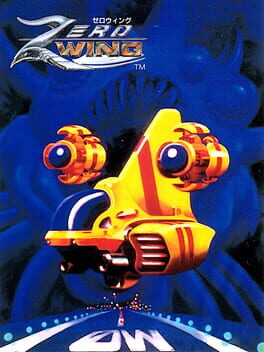
Zero Wing
Zero Wing is a side-scrolling shoot 'em up arcade game, notable for a poorly translated English version for Sega Mega Drive (Genesis) that spawned the "All your base are belong to us" Internet meme. Gameplay includes novel features such as being able to 'tractor' enemy ships, using them to shield your own.
| Released | 1989 |
|---|---|
| Developer | Toaplan |
| Publisher | Toaplan |
Where to buy
Prices are cached and may be out of date — check the storefront before buying.
Platforms & ports
Screenshots
5images — scroll sideways, click to enlarge
Video
Story
Set in 2101, the game follows the signing of a peace treaty between the United Nations and CATS, an alien cyborg. However, CATS breaks the covenant and takes control of the Japanese space colonies. The protagonist Trent leads a ZIG space craft, which had managed to escape from the mothership destroyed by CATS, with the aim to defeat enemy forces, avenge the mothership and its crew and liberate the Earth.
History
Zero Wing is a 1989 horizontally scrolling shooter video game developed by Toaplan and published by Namco for Japanese arcades; in North America, it was distributed by Williams Electronics. Controlling the ZIG space fighter craft, players assume the role of protagonist Trent in a last-ditch effort to overthrow the alien space pirate organization CATS (Abigor in the PC Engine version). It was the eighth shoot 'em up game from Toaplan, and their fourteenth video game overall.
Headed by development chief Toshiaki Ōta, Zero Wing was created by most of the same team that previously worked on several projects at Toaplan, initially starting as a project not intended for commercial release but to train new recruits before being ultimately released to the market. The game was later ported to other platforms, each one featuring several changes or additions compared with the original version.
Zero Wing enjoyed a degree of success in arcades and its home conversions were met with mostly positive reception from critics. The European Mega Drive version later gained renewed popularity due to the "All your base are belong to us" internet meme, which plays off the badly translated introductory cutscene. The rights to the title are owned by Tatsujin, a Japanese company formed by Masahiro Yuge. The Mega Drive version was later released in North America by independent publisher Retro-Bit in 2020 as well as the Nintendo Classics service.
Gameplay
Zero Wing is a science fiction-themed side-scrolling shooter similar to Hellfire, where players assume the role of Trent taking control of the ZIG space fighter craft through eight increasingly difficult levels, each with a boss at the end that must be fought before progressing any further, in a last-ditch effort to overthrow the alien cyborg CATS as the main objective. As far as side-scrolling shooters go, the title initially appears to be very standard, as players control their craft over a constantly scrolling background and the scenery never stops moving until the stage boss is reached.
A unique gameplay feature is the "Seizer Beam" system; during gameplay, players can grab certain enemies and hold them as shield against enemy fire or launch them against enemies. There are three types of weapons in the game that can be switched between after destroying incoming carriers by picking up a color-changing item ranging from the "Red Cannon" shot, the "Blue Laser" and the "Green Homing" missiles. Each weapon can be upgraded by picking up an item of the same color. Other items can also be grabbed along the way such as speed increasers, 1UPs and a bomb module capable of obliterating any enemy caught within its blast radius that can also be triggered after taking enemy hits.
Depending on the settings in the arcade version, the title uses either a checkpoint system in which a downed single player will start off at the beginning of the checkpoint they managed to reach before dying, or a respawn system where their ship immediately starts at the location where they died. Getting hit by enemy fire or colliding against solid stage obstacles will result in losing a life, as well as a penalty of decreasing the ship's firepower and speed to his original state and once all lives are lost, the game is over unless the players insert more credits into the arcade machine to continue playing. The game loops back to the first stage after completing the last stage as with previous titles from Toaplan, with each one increasing the difficulty and enemies fire denser bullet patterns as well as spawning extra bullets when destroyed.
Synopsis
The backstory of Zero Wing varies between each version, but the plot within the game itself remains consistent. Set in 2101, the game follows the signing of a peace treaty between the United Nations (also translated as the Milky Way Federation) and CATS, a space pirate organization, who later breaks the covenant and takes control of the Japanese/Federation space colonies. The protagonist, Trent, pilots a ZIG spacecraft that managed to escape from a mothership destroyed by a representative of CATS. His aim is to defeat enemy forces, avenge the mothership and its crew, and liberate Earth.
However, in the PC Engine version, the story is different. CATS is replaced by an organization called Abigor, led by a man named Ludwig and his right-hand woman, Seiren. Abigor attacks the Galactic Federation, and the ZIG, piloted by Masato Tachibana, is sent to repel them. It is eventually revealed that the Federation dispatcher's sister, Airen, who had been working as an undercover spy to alert the Federation about Abigor's attack, is arrested by Seiren and turned over to Ludwig. After Ludwig chooses to spare Airen's life, Tachibana communicates with Ludwig, who challenges him to a battle with the condition that Airen will be returned if Tachibana wins. Tachibana accepts and destroys Ludwig's ship, after which Ludwig relinquishes Airen before committing suicide. Airen and Tachibana then celebrate their victory before returning to Earth offscreen.
Development
Zero Wing was created by most of the same team that previously worked on several projects at Toaplan, with members of the development staff recounting its history through various Japanese publications. Toshiaki Ōta was at the helm as development chief and also served as programmer alongside Hiroaki Furukawa and Tatsuya Uemura. Uemura also acted as composer along with Masahiro Yuge and Toshiaki Tomizawa. Artists Miho Hayashi, Naoki Ogiwara and Shintarō Nakaoka created the artwork while Sanae Nitō and Yuko Tataka served as character designers.
Uemura stated that Zero Wing originally started as a project not intended for commercial launch to train new recruits at Toaplan, handling training for new hires while using his work and engine from Hellfire before ultimately deciding with releasing the game to the market, which made it a more practical learning experience for the new developers. Uemura, however, felt that both stage design and characters were "cobbled together", leading the game's world being "kind of a mess" and he also stated the project turned into a "battle royale", as staff from both Hellfire and Truxton were mixed with the new recruits. Sound also proved to be very divisive as Uemura, Yuge and Tomizawa wrote several songs for the game with their own individual styles, though Uemura claimed this was due to dividing the work, while Yuge stated he would go to rest and drink after being stuck when composing for the title during work hours. Due to being a training project, Uemura stated that the team had freedom to "just fool around" and several features were integrated into the title such as warps, which was taken from Slap Fight. Uemura also revealed that the reason for enemies spawning suicide bullets during loops of higher difficulty was in response to hardware limitations regarding sprites. Both the single-player and co-op versions were also planned from the beginning of development due to pressure to make two-player games at the time. The alien Pipiru was designed by Ogiwara, though Uemura claimed such character was not planned.
The Mega Drive version of Zero Wing was created by the same staff responsible for the arcade version, with Uemura overseeing development in-house. Both Uemura and Tataka have stated that working with the Mega Drive proved to be difficult due to several restrictions imposed by the hardware. According to both Uemura and Yuge, the poor English translation of the Mega Drive version was handled by a member of Toaplan in charge of export and overseas business whose English was "really terrible". The Mega Drive port features arranged music by Noriyuki Iwadare. The PC Engine CD-ROM² version was outsourced by an "acquaintance" from defunct developer Orca, with Uemura handling sound.
To expand the plot, the Mega Drive version added an introductory sequence to the game. This introduction does not appear in the arcade original nor in the PC Engine CD-ROM² versions; rather, a different intro takes place with a blue-windowed ZIG. The PC Engine CD-ROM² also added two new levels: 5th (Deeva) and 10th (Vacura).…
Adapted from Wikipedia , licensed under CC BY-SA 4.0. Text may have been shortened.